
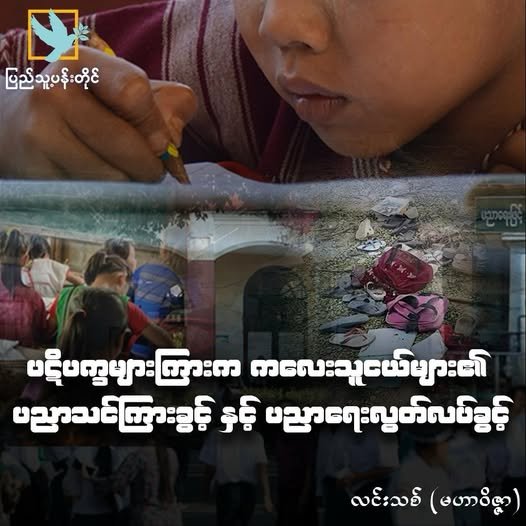
A Generation Caught in Conflict: Why Every Child Deserves the Right to Learn
By Lin Thit (M.A.)
“Ko Lin Thit, should I let my son sit for the placement test and return to school?”
It was a simple question from an acquaintance back in May, yet it carried the weight of thousands of families across Myanmar. Like many parents living through conflict, she was torn between political convictions and her child's future. And like many others, I struggled to answer immediately.
For years, Myanmar's children have become unintended victims of a crisis they did not create.
Following the 2021 military coup, millions of students experienced severe disruptions to their education. Many joined the Civil Disobedience Movement (CDM) alongside their teachers and families, refusing to participate in institutions under military control. Others found themselves trapped between conflict, displacement, financial hardship, and the fear of being judged for whatever choice they made.
As someone who spent two academic years teaching at a Spring Revolution online school for CDM students, I witnessed these struggles firsthand.
One of the most sensitive debates among teachers and students was whether children who returned to military-run schools should be criticized or socially excluded. My answer has always remained the same: children should never be punished for seeking an education.
Education is not merely about textbooks and examinations. Schools are spaces where children learn to socialize, develop emotionally, and experience the ordinary joys of childhood. In a time when war and uncertainty have stolen so much from Myanmar's young generation, denying them access to learning only deepens their suffering.
Children did not create this conflict. They should not be forced to bear its consequences.
During the early years after the coup, many students who continued attending school felt intense guilt and fear. Some were even afraid to wear their white-and-green school uniforms in public. Yet these children and their parents were not responsible for the political circumstances surrounding them. They were simply trying to survive while protecting their future.
As the conflict dragged on, many families became increasingly worried that their children were losing entire years of education. For children growing up amid displacement and armed conflict, every lost school year means lost opportunities and long-term consequences.
Consequently, many parents made the difficult decision to re-enroll their children in state schools, not out of political support, but out of concern for their children's futures.
At the same time, many others have been left with no educational opportunities at all.
The National Unity Government (NUG), ethnic education providers, and various CDM educational initiatives have made remarkable efforts to establish alternative schools and online learning platforms. However, these efforts continue to face enormous challenges.
Schools in resistance-controlled areas have repeatedly become targets of attacks. In many communities, ongoing insecurity has made learning environments unstable and dangerous. Meanwhile, online education remains inaccessible to many families due to poverty, unreliable internet connections, lack of devices, and constant displacement.
As an online teacher, I watched students disappear from my virtual classrooms one by one.
Some lost internet access. Others had to flee advancing military operations. Some could no longer afford mobile data, while many were forced to abandon education entirely in order to work and support their families.
These are not isolated stories. They represent the reality of countless children across Myanmar today.
The emotional toll has also been devastating.
Many children who missed years of education now struggle to return to school due to age differences, social stigma, and criticism from their peers. Others remain confined indoors by safety concerns, isolated from friends and normal childhood experiences.
I still remember one teenager—the son of a CDM teacher—telling me:
"Teacher, I feel like I'm losing my mind. My mother is too worried to let me go outside. I'm afraid of being forcibly conscripted. Sometimes I hate my life so much that I want to end it."
Eventually, I encouraged his mother to send him back to school.
The transition was not easy. He faced criticism and had to adapt to being older than many of his classmates. But over time, something remarkable happened.
He regained a sense of normalcy.
He rebuilt friendships. He began discussing social issues with his peers. One day, he proudly told me:
"Teacher, my friends and I now talk about the revolution and the dangers of the conscription law at school."
At that moment, I realized something important.
The revolution is not only fought by those carrying weapons or leading political movements.
Sometimes, it is quietly carried forward by children sitting in classrooms.
Not every child who enters a state school becomes a supporter of the regime. Some enter those spaces carrying questions, critical thinking, and hopes for a different future. Some learn to distinguish right from wrong through lived experiences. Others quietly become seeds for future change.
This is why it is time to move beyond viewing education through rigid political divisions.
Children's right to education must be protected regardless of where or how they access learning.
Parents should not be condemned for making difficult decisions to secure their children's futures. Educational institutions and political stakeholders should focus on creating protective policies that support all children rather than deepening divisions among them.
The conflict has already taken too much from Myanmar's younger generation.
It should not also take away their right to learn.
Children did not choose this war. They should not be punished for surviving it.
Myanmar may not yet be free, but we are long overdue in granting our children something essential:
the freedom to learn, to grow, and to dream beyond conflict.
[This article is published as part of People's Goal's effort to promote constructive dialogue and provide space for diverse perspectives that contribute to strengthening democratic values and revolutionary resilience. The opinions and arguments presented herein are those of the author alone and should not be interpreted as representing the official views, positions, or policies of People's Goal.]