

■ Lin Thit (Master of Arts)
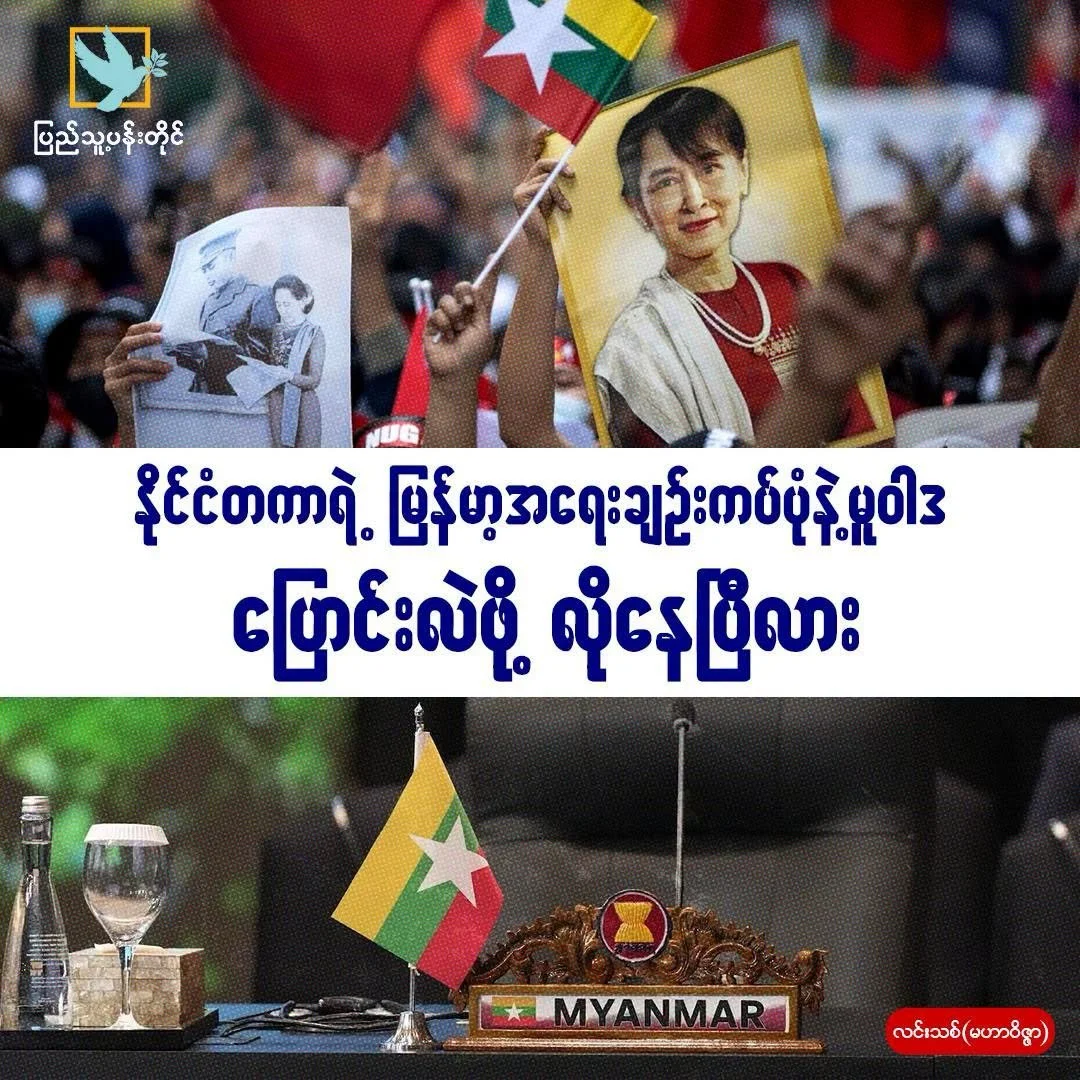
Following ASEAN Special Envoy and Philippine Foreign Secretary Maria Theresa Lazaro’s visit to Naypyidaw—where she had to depart without being able to meet State Counsellor Daw Aung San Suu Kyi—reading news reports stating that ASEAN is still holding onto the Five-Point Consensus serves as a reminder of the core truth that is gradually fading amidst the growing complexity of the Myanmar conflict.
More than five and a half years into the military coup, while I am grateful for the international community's vocal support,pressure, analytical proposals, humanitarian aid, and conflict resolution efforts—including the ASEAN Five-Point Consensus—it feels as though these efforts are focused merely on trimming the branches of the conflict.
In reality, this problem stems from one very clear cause: the military coup. Returning state power to the people is the most fundamental way to cut off the root of the problem.
Although the root cause of this problem originated from an individual's desire to seize power, the conflict has grown exponentially because the military he controls has used force to implement and sustain it. Consequently, cutting off the root of this conflict is no longer a simple matter; it has reached a state where it must be forcefully dug up and severed down to the very roots.
However, from the perspective of ASEAN, neighboring countries, and the international community, cutting off the root of the conflict has not made it to the priority list. Their conflict resolution models also appear to be approaches where they try to tackle the visible, sprawling, and tangled branches of the conflict on the ground using whatever methods are within their immediate view.
On the other hand, because the magnitude of pressure required to sever the taproot and trunk of the conflict is overwhelmingly complex, we also see approaches and urgings driven by the assumption that focusing on the branches and making things look superficially acceptable should be enough.
The people of Myanmar, who are enduring the negative consequences of the conflict with their lives, livelihoods, and properties, are struggling daily to survive amidst the oppression of the dictatorship, the aftermath of war, and injustices.For them, cutting off a single branch offers only temporary relief, while the constant threat of a new branch sprouting remains.
Why? Because the taproot that keeps those branches alive has not yet been severed.
When Min Aung Hlaing's seizure of power led him to utilize the entire military to maintain his grip on power, it became a nationwide crisis. As long as power is not returned, new conflicts will continue to emerge in various forms and from various perspectives as a result of efforts to preserve that power.
If a battle can be stopped today, another military conflict could arise tomorrow. If a humanitarian crisis can be resolved today, another crisis could occur tomorrow. If a war crime can be prevented today, further injustices will continue to occur as long as the dictatorial machinery that enables those crimes to be committed has not collapsed.
In other words, unless the international community can sever the root of this conflict, it will continue to spin in a cycle of perpetually chasing and addressing the newly arising consequences of the conflict.
At this point, the international community needs to answer one clear question:
Is the true priority in Myanmar's affairs to individually address the consequences caused by the coup, or to put an end to the root cause of the coup that continuously generates those consequences?
Will they pressure for the return of power, or will they support the objectives and actions of the revolutionary forces striving to cut the taproot of the dictatorship? This choice is the crucial factor that will determine whether the Myanmar conflict can truly reach its final conclusion.
As long as the taproot of the dictatorship remains alive, the country's natural resources and economic assets will continue to be devoured and utilized to sustain power. From there, new conflicts, new war crimes, and new human rights violations will continue to sprout as new branches.
Therefore, in approaching Myanmar's affairs, the international community needs to shift its policy from one that focuses solely on addressing consequences to one that prioritizes ending the root cause.
No matter how much you prune the branches, as long as the taproot is intact, the tree will continue to thrive. Myanmar's conflict needs to be viewed in the exact same light.
What is needed in Myanmar's affairs is not merely stopping individual conflicts, but putting an end to the root source that continuously breeds these conflicts. As long as the consequences are chased and addressed without resolving the root cause, the Myanmar conflict will never come to an end.
I would urge the international community to truly take a stand on severing the taproot rather than endlessly pruning the branches.
[This article has been selected, edited, and presented as a segment with the intention of strengthening the revolution and enabling the general public to engage with and analyze diverse perspectives. The views expressed in the article belong solely to the author and do not necessarily reflect the stance of People’s Goal. Readers are welcome to write comments and discuss the article.]