
“Holding an Election in Phases Is an Admission”: A People’s Perspective on Myanmar’s Political Reality
“The fact that they are holding the election in different phases is an admission that they do not represent the entire nation.”
This reflection is drawn from a People’s Goal (Thought Process Program) panel discussion on “How to Counter the SAC’s Sham Election”, held in November 2025. The discussion brought together multiple voices to examine the military’s planned election, the current stage of Myanmar’s resistance, and the political pathways toward a federal democratic future.
This article highlights and reflects on the key political arguments shared by U Sithu Maung, a winning MP from the 2020 general election. His contributions focused on legitimacy, political tolerance, and the urgent need for unity and shared rule within Myanmar’s revolutionary movement.
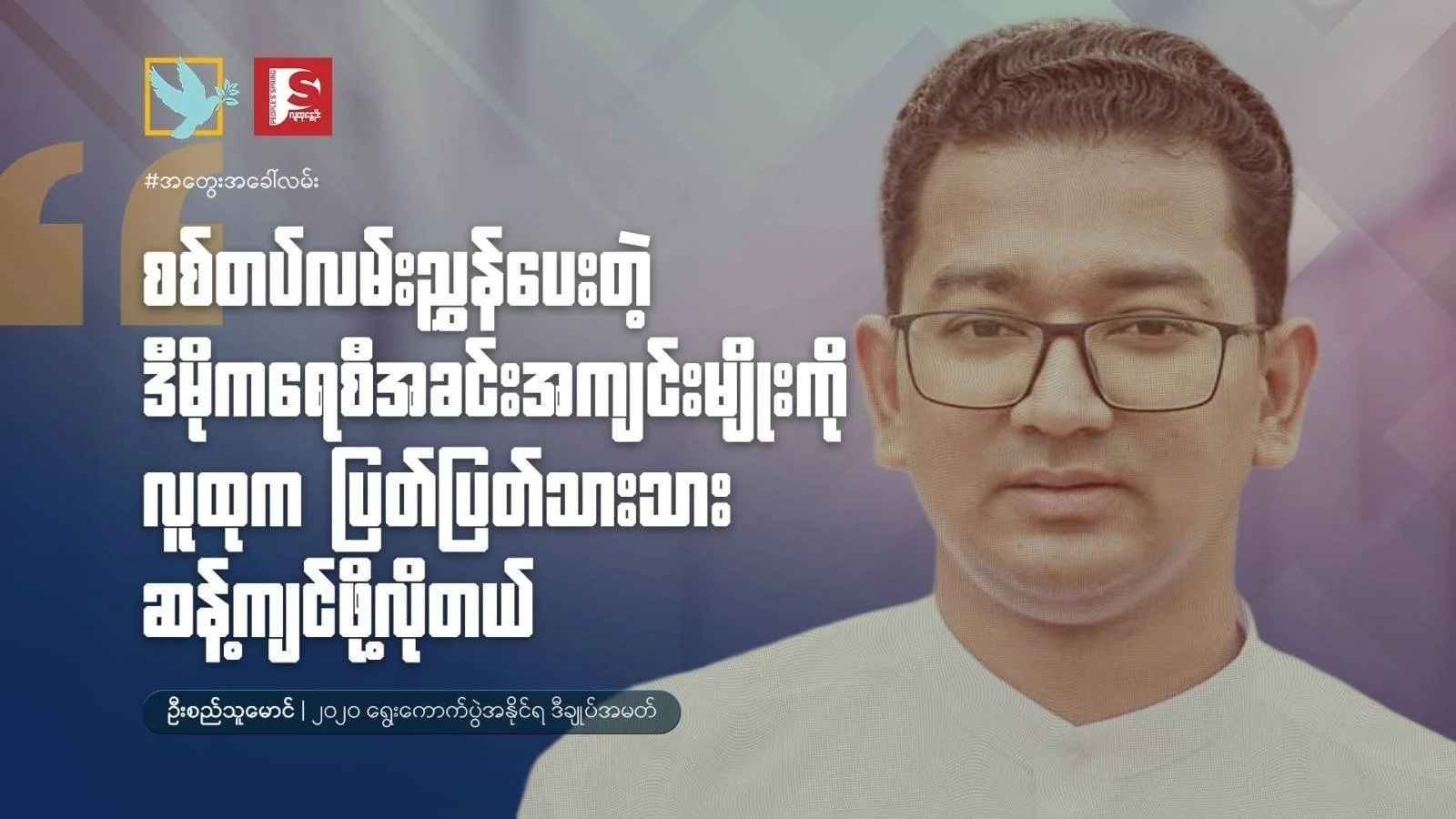
"The public needs to decisively oppose the kind of 'disciplined democracy' directed by the military.”
Why the Public Should Reject the Military’s Election
U Sithu Maung explains the issue in simple terms. Myanmar does not suffer from a lack of elections, but from a lack of political tolerance. Whenever an election result does not favor the military leadership, arrests, force, and manipulation follow. This pattern has repeated itself, most recently after the 2020 election, and mirrors earlier experiences such as 1990.
For many people, the coup created a clear and painful understanding that their votes had been rendered meaningless. The military’s current plan to hold another election, often framed as a return to order or stability, offers only a tightly controlled version of democracy. In this system, the public is allowed to participate only within boundaries set by the military. According to U Sithu Maung, this is not democracy and must be firmly opposed.
Five Years into the Revolution: What Has Changed
Myanmar’s resistance movement has now entered its fifth year. Politically, one of the most significant early steps was the abolition of the 2008 Constitution, followed by the adoption of the Federal Democracy Charter. This charter provided stronger foundations for ethnic equality and future federal union building than previous political frameworks.
However, turning principles into practice has been difficult. A major challenge has been trust. Historical grievances, ethnic divisions, and tensions built over decades cannot be resolved quickly. While many revolutionary forces now administer their own territories, U Sithu Maung cautions that local control alone does not mean national success.
To move forward, federalism must be practiced, not just declared. This means power sharing, shared rule, and the parallel development of strong central coordination alongside local governance.
One Country, Two Realities
U Sithu Maung speaks openly about the current situation in Myanmar. The military does not control the entire country, and its decision to conduct elections in phases is an implicit acknowledgment of this reality. At the same time, areas governed by the NUG, local PDFs, and ethnic revolutionary organizations must also move beyond symbolic federalism and begin practicing it in daily governance.
He notes that several political agreements already exist, including the Federal Democracy Charter, joint statements, and shared principles adopted by multiple revolutionary actors. What remains urgent is a Common Political Agreement that can unite these forces in a practical and binding way, guiding both political coordination and long term nation building.
A Message to Political Parties and Candidates
For those planning to contest the military backed election, U Sithu Maung offers a clear warning. The military has openly stated which parties it supports and which outcomes it will accept. Parties and individuals who previously aligned themselves with the military have already experienced marginalization and removal once they were no longer useful.
While the military’s election may proceed, it cannot stop the people from continuing their own path. Legitimacy, he argues, does not come from participation in a predetermined process but from standing with the people’s political will.
What Legitimacy Really Means After the Election
Looking ahead, U Sithu Maung predicts that any post election military administration will remain internationally weak and isolated, facing legal challenges and limited recognition. It may function only as a de facto authority rather than a legitimate government.
In contrast, the revolutionary side continues to ground its legitimacy in the mandate given by the people in the 2020 election. This mandate is not held for the benefit of any single party or individual but as a political trust, to be carried until genuinely free and fair elections can be held for the future of the country.
From Spring Revolution to People’s Revolution
As the struggle continues, U Sithu Maung reflects on how Myanmar’s movement has transformed. What began as a Spring Revolution has grown into a broader People’s Revolution, shaped by resilience, sacrifice, and learning through struggle. Success and setbacks will continue to come and go, but what remains constant is the will of the people.
“Our freedom is not secured until everyone is freed.” This belief, he notes, is now more widely shared than ever. The challenge ahead lies in deepening trust, strengthening cooperation, and turning shared principles into shared action for a federal democratic future.