
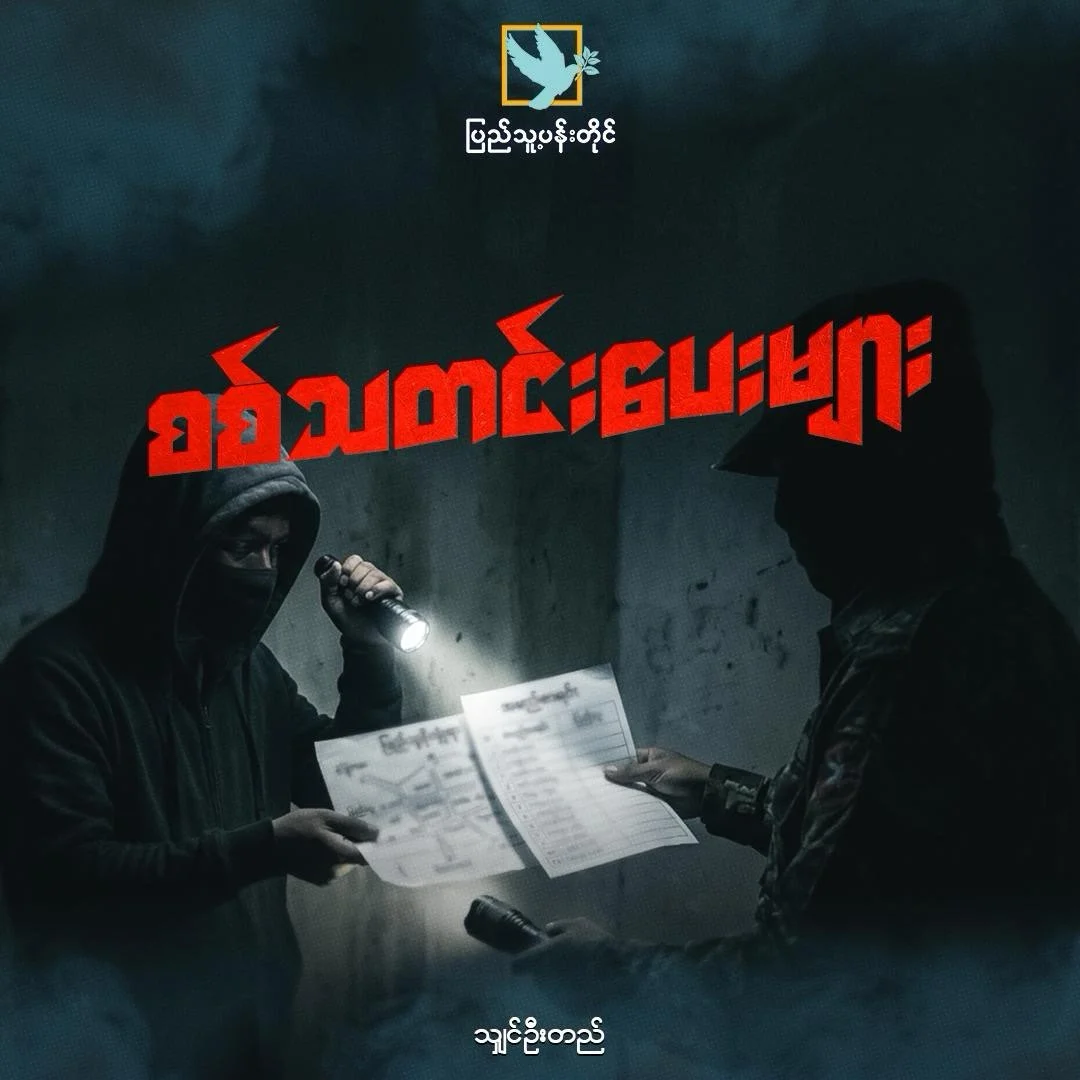
Military Informants
By: Shin Oo Te
In my home region, airstrikes have caused devastating destruction over the past few years. Whenever even a small crowd gathers in a village, a military aircraft seems to appear overhead soon after. Beyond the immediate suspicion of a “Dalan” (informant), people desperately search for other explanations. Is it Starlink? Is the military monitoring us around the clock through satellites? Is it merely coincidence that bombs fall exactly when meetings take place?
No matter how many theories emerge, we always return to the same conclusion: someone provided information. As casualties continue to rise, public anger is directed not only at the military, but also at the invisible “Dalan” believed to be living among the people.
Who Is the Dalan?
When revolutionary forces recently succeeded in capturing a town, many locals and supporters celebrated with joy. Yet the first thought that crossed my mind was the exposure of informants. High-ranking enemy officials had been captured. Surely, I thought, they could be questioned about who had been feeding them intelligence.
After some time passed without hearing any updates, I contacted individuals within the leadership. Their answer surprised me.
“We asked,” they said.
“Did they answer?”
“Yes, they did.”
But then came the most difficult part:
“We cannot do anything about it.”
I will explain why at the end of this article.
Information: The Lifeblood of War
War is not a street fight or a gang conflict. It involves long-range weapons, strategic coordination, and calculated operations. The core distinction lies in intelligence.
Basic military tactics revolve around approaching the enemy without detection. Advanced strategy depends on two things: protecting your own secrets while uncovering the enemy’s. The side that succeeds in both gains the advantage.
That is why communication and reconnaissance are central to every military operation.
The Enigma Machine
The computers and communication technologies we use today partly emerged from efforts to break enemy codes during wartime. During World War II, the German Enigma encryption system was famously cracked by British mathematician Alan Turing.
To protect one’s own operations while gathering enemy intelligence, a strong communication system is essential. By now, the revolutionary forces of Myanmar likely understand this reality deeply.
Types of Intelligence Gathering
The most effective intelligence often comes from human sources. Broadly speaking, these can be divided into two categories: spies and informants.
Spies
Spies are usually trained operatives who infiltrate the opposing side. One famous example is Eli Cohen, the Israeli spy who successfully penetrated the Syrian military establishment and rose to a high-ranking position.
He once recommended planting eucalyptus trees near frontline military bases to provide shade. Later, during the Six-Day War, Israel used those same trees to easily identify and bomb Syrian positions.
These operatives are often called “sleeper agents.” Others become “double agents,” feeding false information back to their original side.
Recruited Assets
Another method involves persuading someone from the enemy side to cooperate. During the American Revolutionary War, the British attempted to recruit Benedict Arnold to surrender West Point, though the plan was ultimately exposed.
The “Dalan” or Traitor
Unlike spies, who operate professionally, a “Dalan” is often an ordinary civilian or a self-initiated informant.
During the Vietnam War, some villagers revealed Viet Cong tunnel locations to the U.S. military, often not for money, but out of fear for their own safety. Others, such as civilians who identified Jews to the Nazis during the Holocaust, acted because of ideological alignment.
In most cases, informants are motivated either by fear or personal benefit.
The Myanmar Context: The Bitter Weight of Suspicion
Myanmar’s situation is uniquely complicated. In many areas, the conventional laws of war no longer function effectively. In a civil conflict deeply shaped by ethnicity and political fragmentation, professional espionage networks are relatively rare. More often, intelligence leaks come from individuals within the community itself.
We must also remember the painful history following the 1988 uprising, when accusations of being military informants led to revolutionary members killing their own comrades without evidence. Paranoia itself became a weapon.
From my own experience training soldiers, many were initially suspicious of CDM (Civil Disobedience Movement) soldiers. When I taught map reading and heavy weapons, some eventually remarked:
“If he were truly a spy, none of us would still be alive.”
We should neither trust blindly nor surrender to extreme paranoia. It is unlikely that the military had systematically planted large numbers of sleeper agents during 2021 or 2022, especially given that they themselves did not anticipate the scale of the uprising. Furthermore, the military intelligence apparatus that once existed under Khin Nyunt was largely dismantled long ago.
The “Normalization” of the Dalan Label
In 2021, the phrase “clearing Dalans” became increasingly common. Strangely, this began even before the armed resistance had fully developed. It became almost fashionable to target ward administrators or individuals perceived as supporting the junta.
While some actions may have been justified under security concerns, we must still ask difficult questions. If someone is killed merely for supporting the opposing side, without actually providing military intelligence, then such an act becomes indistinguishable from murder.
Today, videos celebrating the “elimination of Dalans” circulate widely on social media and are often treated casually. This normalization is dangerous. It creates opportunities for those in power to eliminate personal enemies or for civilians to settle private grudges through false accusations.
I know of one case where a battalion commander labeled someone he personally disliked as a “Dalan” and had the individual killed at a checkpoint. Online, the incident was praised as a “successful operation,” but local residents knew the truth.
There is also a softer form of normalization. People casually joke by calling anyone who behaves badly a “Dalan.”
“He hid the snacks? He’s a Dalan.”
Although intended humorously, this weakens the seriousness of the accusation itself. If everyone becomes a “Dalan” including critics of the revolution, corrupt individuals, or those spreading false hope, then genuine military informants may ultimately disappear into the noise unnoticed.
The People or the Dalan?
Returning to the captured high-ranking official I mentioned earlier: when interrogators reviewed the list of people who had provided information over the last four years, they reached a chilling realization:
“If we eliminated everyone on this list, there would be almost no one left in the region.”
So how should society deal with the issue of Dalans and informants?
I would like to hear your thoughts first. I will share my own perspective in the next article.
This article is curated and edited to strengthen the revolution and encourage diverse perspectives. The views expressed are those of the author and do not necessarily reflect the official stance of People’s Goal. Readers are encouraged to comment and discuss.