
Unchecked Rebels and the Need for a Strategic Overhaul in Public Relations
By: Nway Oo Myaing
Throughout this revolution, we frequently hear reports of revolutionaries killing, arresting, or exploiting one another for personal gain. Every time such news surfaces, the public feels a sense of horror, disbelief, and utter exhaustion.
Despite years passing, incidents of civilians being arrested, beaten, or subjected to excessive force under various accusations continue to occur. These events leave the public spinning with questions: Which organization is responsible for ensuring legal justice? When legal resolutions fail to materialize, public suspicion toward those leading the revolution only grows.
Some revolutionary units tend to cover up and silence reports of killings, beatings, arrests, robberies, corruption, and sexual violence. When citizens speak out against these extrajudicial acts, they are often threatened with warnings like: “Do not overanalyze the law while the region is unstable.” Some groups even go as far as threatening those who do not follow their own restrictive “regulations.”
One local administration body even issued a decree stating:
"If anyone is deemed to have insulted or rebelled against members of the People’s Defense Force (PDF) or revolutionary organizations—whether verbally or physically—they will face effective and severe action."(This statement was later revoked following widespread public backlash.)
Such abuses of influence have caused public fear and distrust to swell. Crimes and extrajudicial acts are also found within battalions and administrative bodies (P-3-L) under the National Unity Government (NUG). The NUG bears full responsibility for this. While some cases are handled directly by the central leadership, no significant progress is often seen. Criticism that the "Central Authority" exists only on paper highlights a glaring organizational weakness.
No matter how much these crimes against civilians and fellow comrades are suppressed or hidden from the media, the public hears about them through various channels. These reports are not merely rumors, fake news, or fabrications meant to tarnish an organization's reputation; most are verified instances of misconduct. Yet, the public is afraid to share, expose, or discuss them openly. They live as if they are blind and deaf because of a total lack of the rule of law. Some armed groups draft laws as they please, only to be the first to break them. When a civilian breaks these "laws," they are punished; when the groups themselves commit crimes, there is no one to hold them accountable.
This reinforces the toxic "Might Makes Right" (the one with the gun is always right) mentality. It eclipses the principle that "the powerful must be the most magnanimous," replacing it with the misconception that "the powerful is the boss." It makes one question the very purpose of having that power in the first place.
When the very groups claiming to "protect the people’s security" engage in unchecked lawlessness, the public feels a profound, visceral pain. In many cases of extrajudicial killings, victims' families remain silent for fear of retaliation, but the surrounding community knows the truth. Fear remains like a heavy sediment.
When some civilians say, “We have to fear both sides,” they aren't speaking in clichés. These words are born from their lived experiences.
As a result, the public has begun to treat armed revolutionaries with a mix of loathing and caution. Civilians no longer dare to speak freely in front of armed comrades. They avoid interaction whenever possible. The old feelings of warmth, intimacy, and trust—the desire to rely on and share with a "comrade" have vanished. They are replaced by an uncomfortable, guarded stance and forced smiles. In this way, while living under the same sky, the hearts of the people and the revolutionaries are drifting apart. And when hearts drift apart, everything else follows.
Revolutionary organizations must urgently analyze why the public’s perspective has changed, who is responsible, and why hope is fading. They must find answers and implement reforms immediately.
During this revolution, the common people have suffered the most. They bear the brunt of the terrorist military’s atrocities: loss of education, denial of healthcare, homes burned, food scarcity, shrinking safe zones, and airstrikes. Despite this, the people have bet everything on the revolutionary forces. They looked at these soldiers as their own nephews and sons; they supported them with whatever little they had. Yet, some members have betrayed this trust, bullying the public and committing crimes ranging from personal moral failings to the issuance of irrational organizational decrees.
Furthermore, we see the wives and relatives of some members using the influence of their husbands or sons to act arrogantly, bully, or threaten other civilians. Public trust is also eroded by the lack of transparency in "gate fees" (taxes) collected at checkpoints and the subsequent misappropriation of those funds for personal use.
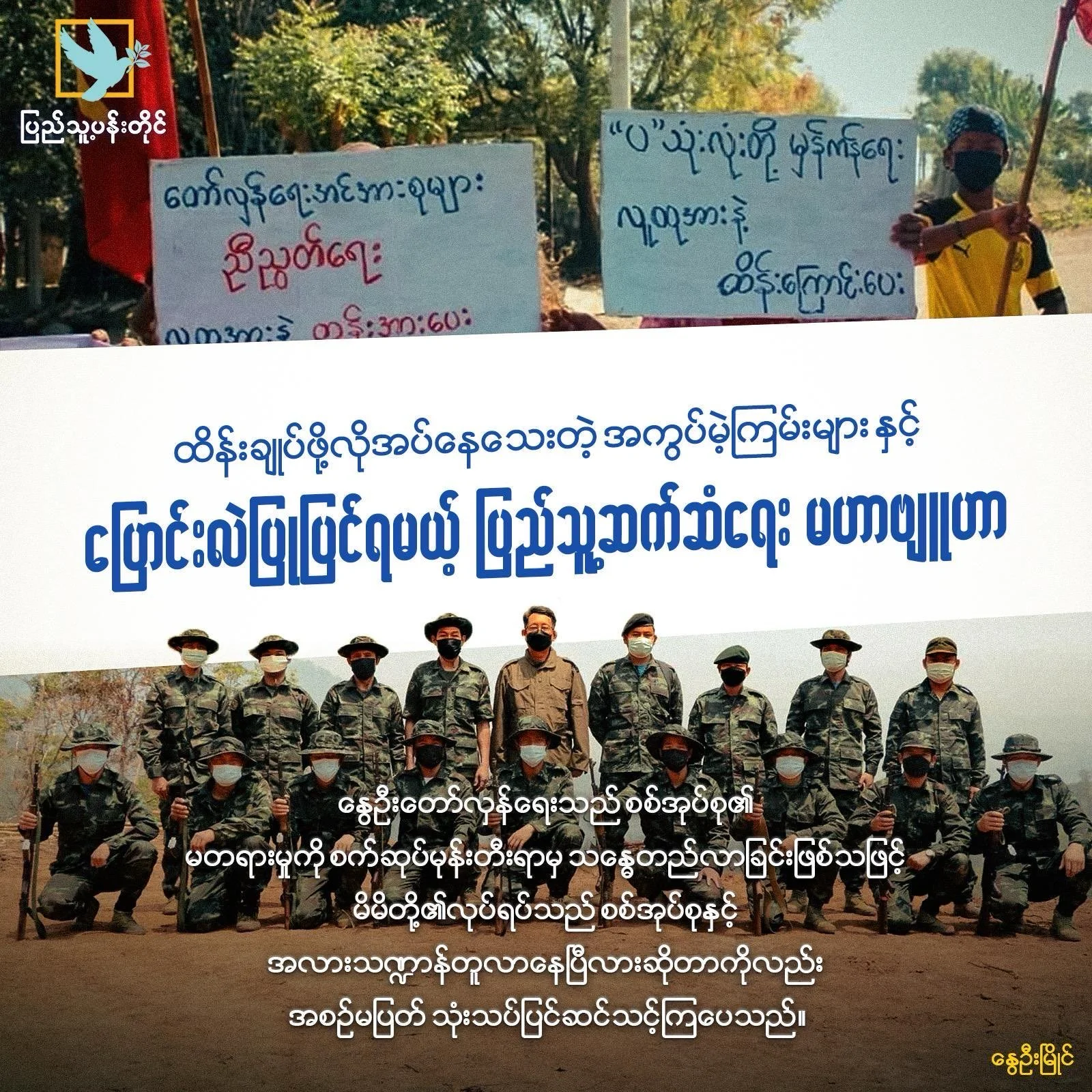
The people have believed in the revolution since day one and they still do. They simply do not trust the corrupt individuals holding the guns. This "Spring Revolution" was born out of a hatred for the injustice of the military junta; therefore, revolutionaries must constantly reflect: Are our actions starting to resemble those of the enemy?
Every revolutionary group includes "Protecting the People" as a core pillar of its policy. Whether they actually practice this can be seen by the "boiling" reality on the ground. As the saying goes, "One rotting fish spoils the whole boat." It would be senseless for the entire revolution to be tainted by the stench of a few groups or individuals. To prevent this, those in charge must act without bias. For the sake of the revolution's goals, they must effectively handle these issues according to interim laws. This article is an objective call to action.