
A Mother, a Breadwinner, and a Woman in the Resistance
Ma Thu Zar’s journey from a military officer’s wife to a mother, small-business owner, and active supporter of Myanmar’s resistance.
Before the coup, I lived a very different life.
My husband was a Major in the military, and our family lived with privileges that I did not think much about at the time. When I went to the market, there was someone to help carry my basket. When my children went to school, transportation was arranged for officers’ children.
That was the world I knew.
Everything changed after the military coup on 1 February.
For the first few days, my husband continued going out for city security duty. When he came home on 8 February, he told me something that would change our family forever.
“Going out this week was to protect the public, but next week, when we go out again, we will have to crack down on innocent civilians.”
Then he told me:
“I cannot do that.”
We talked about it together. We knew that his decision would not affect only him. It would affect me and our children too. We could lose our home, our income, our security and everything familiar to us.
Still, we made the decision.
On 9 February, using a hospital visit as a reason to leave, my husband made his way to a liberated area and joined the Civil Disobedience Movement.
From that day, my journey began too.
I Took My Children and Followed Him
For our safety, my husband did not contact us for some time.
Around April, I finally heard from him.
“You have to follow me now,” he told me.
I took our children and left.
We were told not to carry identification documents. My children even had to learn to call their father by another name during the journey.
At one point, fighting broke out and we heard gunshots.
I was afraid. I was travelling with my children, and I did not know what would happen to us. I remember thinking:
“My children, this is our fate. Dead or alive, the three of us—mother and children—are in this together.”
I just had to keep going.
That evening, we finally reached my husband.
We were together again. But the life we had known was gone.
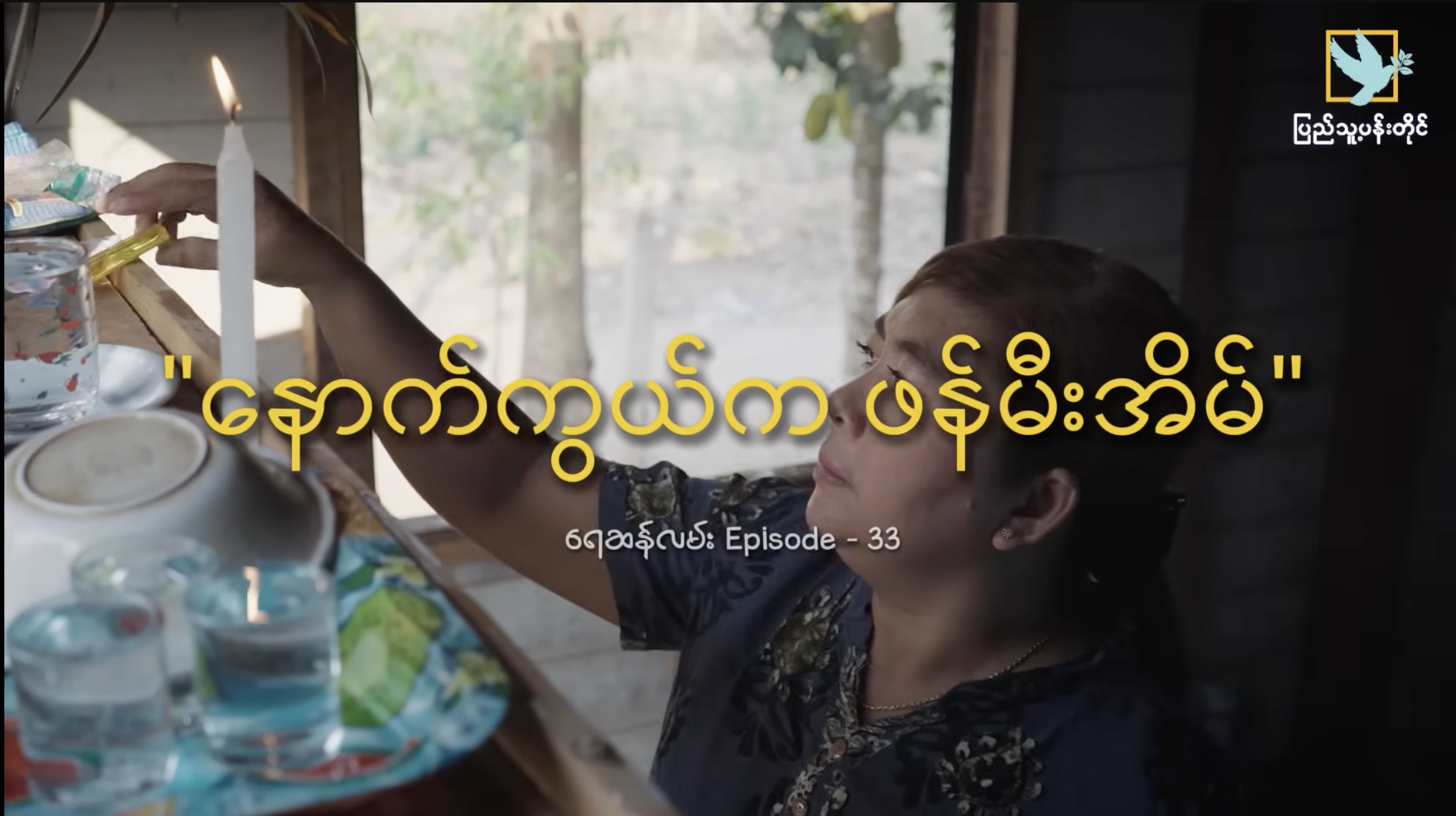
Choosing courage, carrying a family, and standing with the resistance
“No matter how poor or exhausted we are, I am content because we are standing on the side of truth.” — Ma Thu Zar
I Had to Find a Way to Support My Family
We have now been living in the liberated area for about four years.
At first, we received some financial support as a CDM family. When that support stopped, life became much more difficult.
My husband had his responsibilities in the resistance. I had two children to care for, and our family still needed food and other basic necessities.
I had to find a way to earn an income.
With a small amount of initial funding from Pyithu Pan Tine, I started selling rice and charcoal.
It was a very small beginning. I did not have much money to invest, and I was not starting a business in a place with good roads or easy transportation. I had to work with whatever was available.
Sometimes, when there is nobody to make a delivery, I put bags of rice or charcoal on a motorbike and deliver them myself.
When I think about my old life, the difference is striking.
Before, someone carried my basket for me at the market.
Now, I carry bags of rice and charcoal to earn money for my family.
The business may be small, but it allows me to contribute to our household and take responsibility for my children. I have learned to work with what I have and find a way forward.
I Am Also Doing My Part in the Resistance
Taking care of my family does not mean that my responsibility ends at home.
My husband contributes to the resistance in his way, and I contribute in mine.
When comrades come to our home to rest, I take care of their basic needs. When injured comrades or medics need support, I help where I can. I also assist with coordinating and transporting supplies so they can reach the people who need them.
These things may happen away from the frontline, but they are part of how I contribute.
There are many different kinds of work that need to be done. People need food. Injured people need care. Supplies need to reach the right places. Families need income. Children need to be looked after.
I do what I can.
I Am a Mother Too
Through all of this, I am still a mother of two children.
My youngest daughter lives with me and attends the local village school. She passed Grade 1.
My eldest son is in Thailand, where someone close to our family has helped him continue his education.
Of course, I worry about my children. I want them to be safe. I want them to have an education. And I want our family to live together again.
Sometimes, my husband reminds me that our children are not the only ones whose lives and education have been disrupted.
“There are so many children out here in the forest who cannot attend school,” he tells me. “Don’t worry only about our own child.”
Living here has taught me to look beyond the situation of my own family and understand what many other families are going through.
I See Life Differently Now
When I lived within the military community, my world was small.
I did not fully understand how people outside that community lived or the struggles they faced.
It was only after leaving that life that I began to understand.
I learned what it feels like to worry about money. I learned what it means to depend on other people’s kindness. I learned how difficult even ordinary things can become when you live in an area affected by conflict.
Most importantly, I learned empathy.
I lost many of the comforts I once had, but I gained a different understanding of people and of life.
Now, no matter how poor or exhausted we are, I am content because I know which side I have chosen to stand on.
One Woman’s Story, Among Many
Ma Thu Zar’s first-person account is deeply personal. But her experience also opens a window onto a much wider story: the diverse and often less visible roles women are playing across Myanmar’s resistance.
Women’s participation does not take a single form. In different areas, women serve on the frontline and work as medics, teachers, community organizers and providers. Some run small businesses to sustain their families. Others care for displaced communities, provide food and shelter, support logistics, raise children, or help keep communities functioning amid conflict and displacement.
Much of this work happens away from public attention. Yet these roles are important to sustaining families, communities and the wider resistance.
Ma Thu Zar’s experience is one example.
Her husband’s decision to leave the military transformed the whole family’s life, but she did not remain simply a dependent or a bystander. She adapted to a new reality and took on multiple responsibilities.
As a wife, she stands alongside a husband who left the military and joined the resistance. As a mother, she has raised two children through years of uncertainty and separation. As a breadwinner, she turned a limited amount of start-up support into a small rice and charcoal business. And as a supporter of the resistance, she provides practical care and assistance to comrades, injured personnel and medics, while helping with supplies when needed.
Her journey demonstrates a form of resilience that is both personal and political: the capacity to adapt, provide, care and contribute even when circumstances change dramatically.
This is why women should not be seen only as wives, mothers or victims affected by conflict. Women themselves are active participants in sustaining the resistance.
Their contributions may look different from those on the frontline, but they are no less connected to the ability of families, communities and resistance networks to endure.
A Simple Hope for the Future
After years of uncertainty, Ma Thu Zar’s hope for the future is remarkably simple.
She believes the revolution will succeed. But she does not dream of returning to the privileged life her family once had, nor does she want to return to life in a big city.
Her husband has told her that when the revolution is over, he wants their family to find a small hill and live there peacefully—even without water or electricity.
It is a modest dream, shaped by everything the family has experienced.
The woman who once had someone carry her basket at the market now carries bags of rice and charcoal herself to generate an income. Along the way, she has learned to support her family under difficult circumstances, contribute to the resistance and raise her children through years of uncertainty.
What she hopes for now is not a return to privilege.
It is a future for her children, a chance for her family to be together, and a peaceful life after years of upheaval.
Ma Thu Zar’s journey, therefore, cannot be told only as the story of a Major’s wife. Her husband made the decision to leave the military, but she has carried the consequences of that decision alongside him while building her own role within the resistance.
She is a wife and a mother of two. She is also a breadwinner, a small-business owner, a caregiver and a supporter of the resistance.
Her story is also a reminder of the many women across Myanmar whose contributions take different forms—on the frontline, in clinics and classrooms, within displaced communities, through small businesses, and inside homes that provide care and support.
For Ma Thu Zar, that contribution began with very limited resources and a need to keep her family going. Today, it can be seen in something as ordinary as a motorbike carrying bags of rice and charcoal—a small business sustaining a family while its owner continues to play her own part in the resistance.