

PRESS RELEASE - People's Goal launches “Wind of Change” report, mapping the defection wave inside Myanmar's military
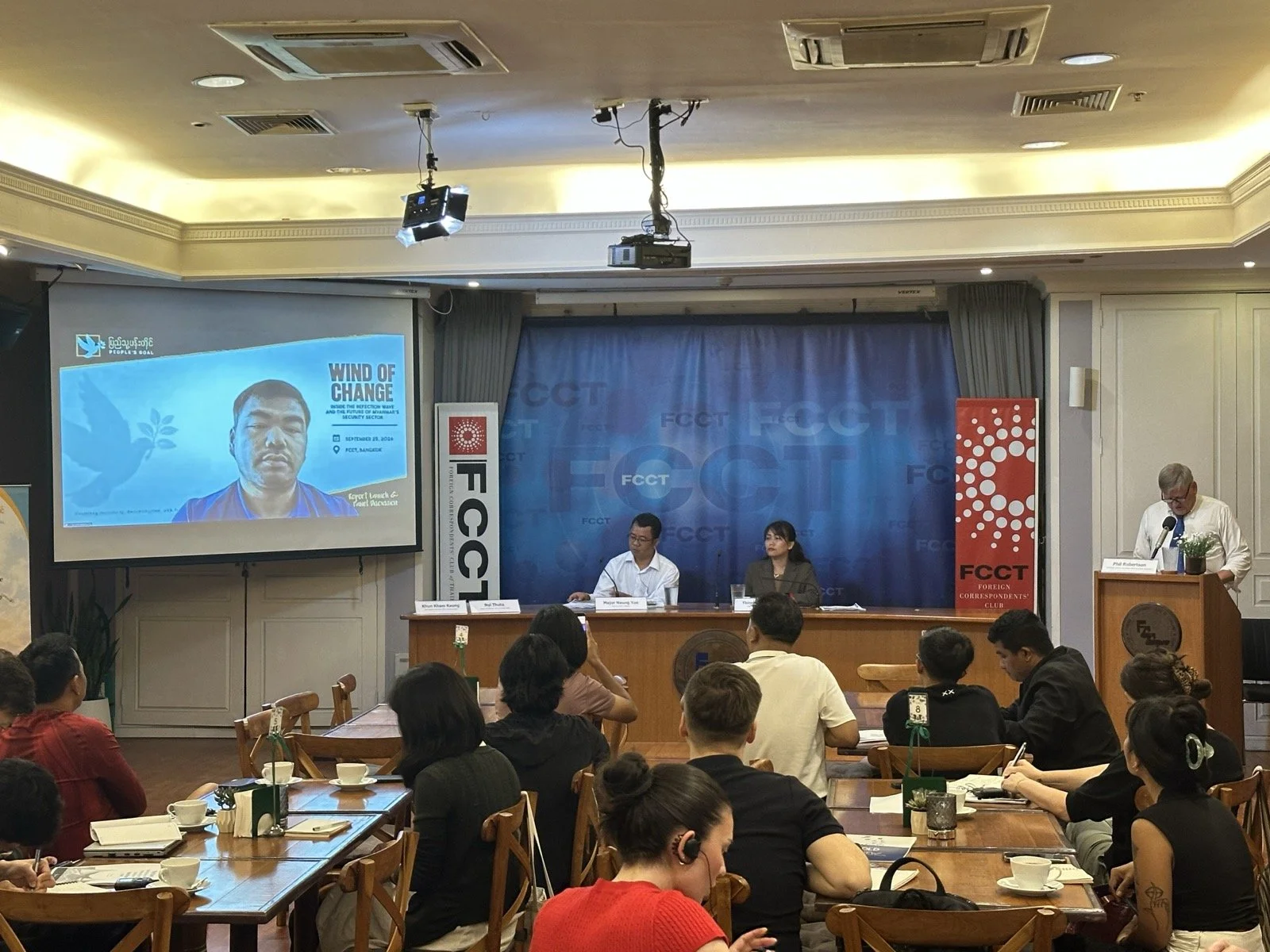
Wind of Change Report Launch at FCCT
New research tracks the Civil Disobedience Movement, surrenders and military defections from 2023 to 2026, and asks what they mean for the future of Myanmar's security sector
New research tracks the Civil Disobedience Movement, surrenders and military defections from 2023 to 2026, and asks what they mean for the future of Myanmar's security sector
BANGKOK — People's Goal today launched Wind of Change: Inside the Defection Wave and the Future of Myanmar's Security Sector, a research report built on the perspectives and assessments of personnel who have defected from Myanmar's military. The report was presented at a panel discussion at the Foreign Correspondents' Club of Thailand (FCCT) in Bangkok.
The report analyses the shift inside the armed forces since the 2021 coup, and particularly since Operation 1027 began in October 2023, covering the Civil Disobedience Movement, surrenders and defections from 2023 to 2026. Based on in-depth surveys and interviews with 60 defectors done between February and August 2026, the report examines why soldiers leave, what happens to them afterwards, how cohesive the military remains, and what defectors believe Myanmar's future security sector should look like.
Major Naung Yoe, a military defector who now works with People's Goal, said: “Many soldiers want to leave but are held back by fear for their families and the loss of their pensions, housing and documents. When they do leave, they need to know they will be safe.”
Khun Kham Kaung, the lead researcher on the report added: “The people we spoke to were clear that Myanmar does not need a reformed version of this military. It needs an entirely new institution under civilian control.”
Some of the report’s key findings are the following:
Why soldiers leave, and what holds them back. Defectors cite four main reasons: moral conviction, the seizure of power from the civilian government, their own surroundings, and loss of trust in the military. Many delayed the decision to defect out of concern for their families and their future, fear about how the process of entering the CDM would go, and the military's hold over pensions, housing, identity documents and their children's education.
Life after defection is better morally but harder materially. Defectors reported they face six main hardships: separation from family, livelihood, security, psychological suffering, language and culture, and a lack of identity documents.
Defections are declining overall, and support for defectors is falling short. Defections remain high in areas controlled by ethnic armed organisations and where civil society networks are strong, such as Chin and Rakhine. But support for defectors is too small in scale, fragmented and not sustainable. International assistance is limited to humanitarian aid, with no dedicated programs, protection arrangements, or legal documents available to defectors.
The military's cohesion is gradually deteriorating. The military can still recruit through paid recruitment and reserve forces, maintain its officer numbers and draw on support from China and Russia. But morale is falling sharply among rank-and-file soldiers, who remain in service primarily out of fear and pressure, and officers are frustrated. Top generals remain bound by shared interests and crimes.
Public support has turned into opposition. Respondents describe public support for the military as not only declining but turning into active opposition, hatred and fear. Genuine support for the military is limited to very few people.
An entirely new institution is needed. Defectors see the current military as completely incompatible with a peaceful, democratic Myanmar and call for a new federal democratic army under civilian control, with no military-run ministries, no reserved 25 percent quota of parliamentary seats for the military, and no military-linked political parties. They propose a phased approach to changing the current military personnel, based on vetting and reintegration for soldiers and junior officers, and accountability for senior officers according to the severity of their crimes.
The 2025 election confers no legitimacy. Respondents firmly stated that the 2025 election, which was held under military emergency rule and excluded parties and large parts of the population, will neither confer legitimacy nor bring change, and serves only as an international shield for the regime.
The report recommended to the international community that defectors need actual pathways to rebuild their lives, and that just providing humanitarian assistance, like more than food and rations, is not enough. The report calls on the international community to help defectors obtain legal residency and work permits, provide them with access to vocational training and new skills, and commit to long-term, sustainable financial support to assist them.
“As of 2023, the National Unity Government (NUG) officially vetted and issued Civil Disobedience Movement (CDM) codes to 15,000 military soldiers and police personnel,” said Thinzar Shunlei Yi, Executive Committee Member of People’s Goal. “However, departures from the junta's forces have continued unabated, with public data indicating that more than 200 soldiers and police officers defect, desert, or surrender every month.”
The discussion at the FCCT was moderated by Phil Robertson of Asia Human Rights and Labour Advocates.
Report availability
A link to the report is available on the People’s Goal website, at https://www.peoplesgoal.org/pgnews/wind-of-change-inside-the-defection-wave-and-the-future-of-myanmars-security-sector
About People's Goal
People’s Goal (PG) is a Myanmar civil society organization founded by defected soldiers who chose to stand with the people and join the resistance movement following the 2021 military coup. Initially established as “People’s Soldiers,”the organization changed its name to “People’s Goal” in 2022 to reflect its broader strategic vision and more inclusive leadership.
For further information, please contact:
1. Naung Yoe (Military Defector)
Executive Committee Member| People’s Goal
Signal: @NY2021.12
Email: peoplesgoal.burma@proton.me
2. Thinzar Shunlei Yi
Executive Committee Member| People’s Goal
Signal: @tzsly.21
Email: peoplesgoal.burma@proton.me
Interviews with the report's authors can be arranged on request. For security reasons, individual respondents in the report are not identified.