

By Phone Ye Naung
The military junta, acting through its rebranded election commission, has publicly announced that its election will be conducted in three distinct phases. Today marks the start of the first phase of this sham election, which is overwhelmingly rejected by the public. Despite the junta’s desperate efforts to force the process forward, the atmosphere remains bleak and desolate.
Leading up to this day, there were staged rehearsals for voting procedures and organized campaigning by those contesting the polls. The Union Election Commission, composed of members handpicked by the military leader, has been manipulating the political landscape to suit the regime’s interests. This includes enacting restrictive electoral laws and arbitrarily deciding which parties are eligible to run and which candidates are permitted to contest, effectively operating as a puppet of the military government.
To understand the true nature of an election, one must examine its fundamental purpose. In a democratic system, an election is the mechanism through which the people select representatives of their choice and delegate their sovereign power. While elections are the lifeblood of democracy, dictators who have seized power often harbor a peculiar fondness for them. This interest, however, does not stem from a genuine respect for the electoral process or the essence of democracy.
Instead, they adopt a democratic facade to manufacture legitimacy. Their goal is to perform a sleight of hand for both domestic and international audiences, masquerading as a legitimately elected government. This type of election, orchestrated by dictators, is what is categorized as an “Authoritarian Election.”
In its pursuit of legitimacy through illegitimate means, the junta employs various tactics to obstruct rival political entities and parties from contesting, carefully engineering the process to ensure that only parties and groups aligned with military interests can compete. By imposing restrictive and unjust criteria for party registration and candidate vetting, it has effectively barred opposition forces from the electoral arena.
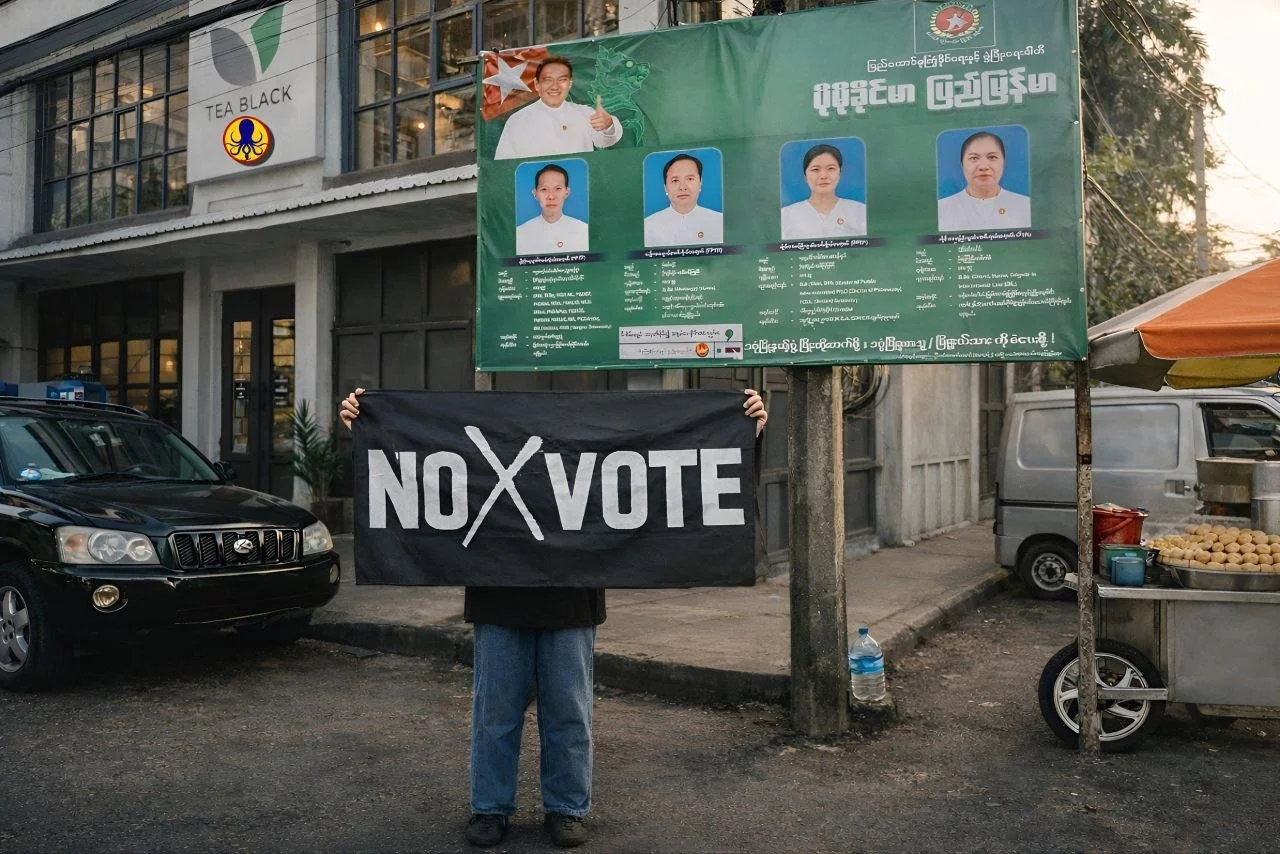
Photo: Members of the Octopus (Public Benefit Youth Organization) hold a “NO VOTE” banner in Dagon Township, Yangon, as part of an anti-dictatorship movement urging the public to boycott the junta’s sham election.
Recently, the military-backed proxy party was reinforced with new personnel handpicked and assigned by the junta leader himself. While this party has historically been a stronghold for retired generals, this latest infusion of newly resigned senior officers reveals a telling reality. The paranoid junta leader lacks confidence even in his own party, feeling compelled to install his closest loyalists to maintain absolute control.
Furthermore, the military has been using various forms of intimidation to coerce the public within its controlled territories into voting under duress. Even local artists and celebrities have been forcibly pressured to endorse the election. Through propaganda films, the junta has portrayed the election as the sole gateway to domestic peace and national development, a blatant distortion of reality.
Once the election proceeds as planned, the regime will repeatedly fabricate the narrative that its actions are legitimate because they emerged from an electoral process. It will likely trumpet respect for the people’s vote to maintain a facade of integrity, claiming to be a legally elected government. Armed with this hollow title of legitimacy, the regime will attempt to re-enter the regional political stage, as it strives to gain whatever acceptance it can from the international community with the backing of certain powerful nations aligned with the regime.
Why are military regimes so desperate to attain “legitimacy”? The answer lies directly in the personal interests of their leaders. Although the second-in-command claimed early in the coup that the regime could survive with only a few allies, the reality is that international legitimacy is essential for them to formalize and protect their global assets, often hidden under various aliases.
To ensure these investments remain secure, a veneer of legality is required. Furthermore, the leaders’ families and inner circle seek freedom from international sanctions to travel abroad for elite education, lucrative career opportunities, or specialized medical treatment.
Even while wielding de facto power over the country, the regime will continue to be stifled by sanctions and remain ineligible for international aid without formal recognition. This is a critical blow to Myanmar, a nation that has shifted from a developing status to a state of severe regression, especially since international assistance serves as a vital pillar sustaining the national economy in many such countries.
Myanmar endured the catastrophic COVID-19 pandemic in 2020, only to be confronted by a military coup in 2021. Consequently, regardless of the inflated figures and data released by the military, the economic reality for individual citizens has drastically worsened.
The middle class has been pushed down into lower socioeconomic strata, while the poor have been plunged into even deeper poverty. With purchasing power severely eroded, families are now forced to limit their spending to absolute essentials. These dire circumstances are unmistakable indicators of the country’s economic freefall.
To bolster this collapsing economy, the military regime is in dire need of substantial international aid. Yet even if such assistance were to materialize at this juncture, it would undoubtedly be funneled toward the personal enrichment of the generals rather than the welfare of the public. They have no intention of implementing initiatives that genuinely serve the people’s interests.
Ultimately, this military-led election will by no means represent a transition from dictatorship to democracy. Despite the pageantry of a vote, the outcome will be nothing more than a cosmetic shift, the same oppressive regime behind a different mask. It must be understood that genuine democracy and an authoritarian-led election are fundamentally irreconcilable, like night and day, traveling on paths that will never meet.
[This article is curated and presented to strengthen the resistance and encourage diverse perspectives among the public. The views expressed are solely those of the author and do not necessarily reflect the official position of People’s Goal. We welcome comments and constructive discussion on the content of this article.]