
By A Former Officer
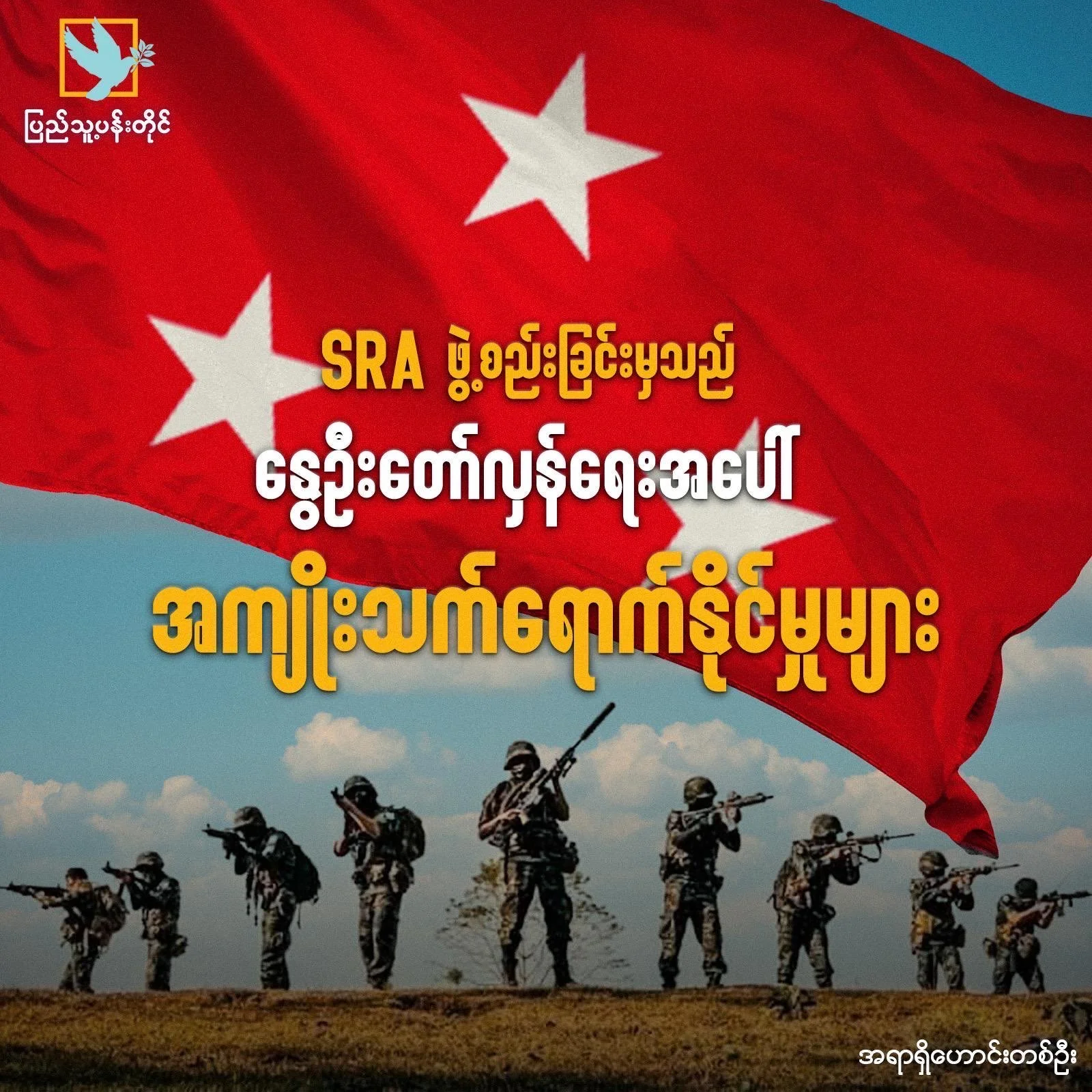
On December 15, an official announcement declared the formation of the Spring Revolution Alliance (SRA), a coalition comprising 19 revolutionary groups. Almost immediately, the military junta and its proxies launched a barrage of divisive propaganda, utilizing their signature “worn-out tactics” and exploiting every possible platform to sow discord.
The junta’s objective is simple. It intends to use the emergence of the SRA as a pretext to incite division not only among revolutionary forces but also within the general public, aiming to weaken, confuse, and ultimately dismantle the movement.
Since Operation 1027, the military has faced systemic failures on all fronts. While it has frantically enforced the military conscription law to replenish its severely depleted manpower, reclaiming all lost urban territories has become a complete impossibility.
(This is precisely why the junta, acutely aware of its internal decay, submissively yielded to China, shamelessly pleading through Chinese mediation for the return of certain towns from the Three Brotherhood Alliance.)
The terrorist junta’s strategy to reclaim lost territory is not built upon its own military prowess or capability. Instead, it relies on exerting pressure through the commission of various war crimes and resorting to desperate trade-offs, sacrificing not only the nation’s sovereignty and dignity but its entire future. These reckless actions stand as undeniable proof of this betrayal.
While the junta appears to focus primarily on the long-established and formidable Ethnic Revolutionary Organizations (EROs), it has also struggled significantly against smaller resistance forces in the plains. However, as these groups were fragmented into isolated units, they lacked the collective strength, outside of the NUG/MOD, required to seize and maintain control over urban centers.
The SRA emerged this December specifically to bridge these gaps and address such tactical weaknesses. For a junta already struggling to contain the NUG/MOD and EROs, the birth of the SRA represents yet another nightmare. Prior to its formation, the revolution was often hindered by territorial disputes and internal frictions among smaller groups, which diluted their overall impact.
With this consolidation of forces, mutual understanding is being strengthened, allowing military operations to be executed with greater synchronization and strategic cohesion.
At this juncture, I would like to address questions regarding whether the SRA is a rival to the NUG or why it has not integrated under the NUG’s command. These narratives are frequently exploited by the junta’s propaganda. The SRA is not a parallel or rival entity to the NUG. Rather, it should be understood as a force that fills strategic gaps within the revolution that the NUG, due to certain constraints, has been unable to bridge.
For some groups, formal alignment with the NUG is complicated by external factors such as pressure from China or by specific military sensitivities that must remain confidential. The SRA emerged as a vital solution to navigate these complexities and bridge divides demanded by the revolution. An analysis of statements made by SRA spokespersons reveals the following key points:
The SRA is not a rival to the NUG and is committed to active military cooperation with it.
To prevent misconceptions, the SRA has sought counsel from Ethnic Revolutionary Organizations (EROs) and intends to maintain close operational partnerships with them.
With member forces spanning from the North to the South, the SRA will coordinate with all revolutionary groups to synchronize military operations nationwide.
The alliance currently boasts a strength of over 10,000 personnel and continues to welcome additional revolutionary groups into the coalition.
The SRA is dedicated to fighting alongside all resistance forces until the military dictatorship is dismantled and a federal democratic system is fully realized.
These pillars clearly reflect the SRA’s strategic positioning and its unwavering long-term vision for the revolution.
Consequently, there has been a unified chorus of support for the SRA from all quarters, including the NUG, NUCC, EROs, and various revolutionary organizations, as well as from Myanmar’s civil society both at home and abroad, who remain vigilantly attuned to every strategic shift in the Spring Revolution’s trajectory.
At a time when strategic military cooperation among revolutionary forces faced significant constraints, the emergence of the SRA has fueled growing optimism among observers. Many view this development as a pivotal step toward a breakthrough, bringing the ultimate success of the Spring Revolution within closer reach.
For revolutionary forces that, for various reasons, have not yet been able to integrate with EROs or the NUG/MOD, the SRA emerges as an optimal alternative with fewer bureaucratic hurdles.
While the analysis above focuses primarily on military cooperation, it is essential to refrain from premature judgment regarding administrative discipline and political transparency. Instead, there is a strong expectation that the SRA will demonstrate constructive progress in these areas. Furthermore, it is hoped that as the SRA transitions from a military formation toward a distinct political identity, it will evolve into an organization that fundamentally honors and prioritizes the will of the people.
I also urge the SRA leadership to proactively prepare for the inherent dynamics and potential challenges that often arise within large-scale coalitions.
In conclusion, the emergence of the SRA represents the integration of a long-awaited and vital component into the machinery of the Spring Revolution, empowering the entire movement to operate with renewed momentum toward final victory.
[This article is curated and presented to strengthen the revolution and encourage diverse perspectives among the public. The views expressed are solely those of the author and do not necessarily reflect the official position of People’s Goal. We welcome comments and constructive discussion.]