
Looking Toward 2026: Revolutionary Youth, Unity, and the Long Road to Change
At the panel discussion “Envisioning 2026: The Spirit and Voice of Revolutionary Youth,” co organized by People’s Goal and People’s Spring, Maung Saungkha, Chief of Operations of the Bamar People’s Liberation Army, shared reflections on the progress, challenges, and future direction of Myanmar’s Spring Revolution.
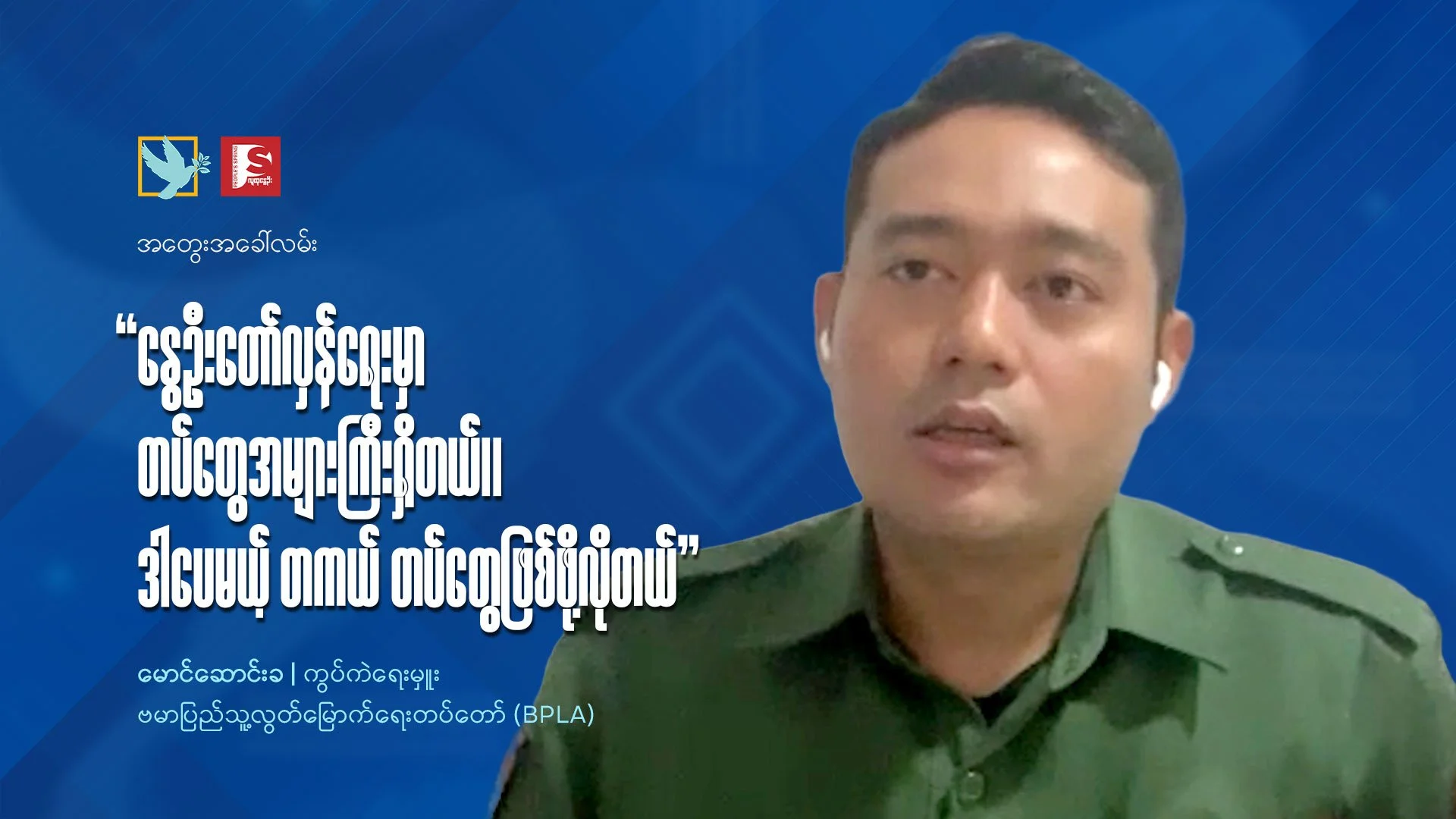
Drawing on the experiences of the past five years, he spoke about the importance of realism, unity among revolutionary forces, and the long term commitment required to dismantle military dictatorship in Myanmar.
Recognizing the Reality of the Battlefield
Maung Saungkha began by emphasizing the importance of honestly assessing the current situation.
“There is no denying that the military currently holds the upper hand on the battlefield. We need to analyze this situation realistically. We need to have the courage to accept the reality.”
According to him, one of the weaknesses of the revolutionary movement during the early years was the difficulty in building structured armed forces with clear command systems. Although many groups took up arms quickly after the coup, establishing a disciplined military structure requires time, training, and coordination.
“A real armed force must be able to operate under a clear chain of command and code of conduct,” he explained. “If troops cannot be coordinated or deployed effectively, it becomes extremely difficult to challenge a nationwide military force like the junta.”
Over the past several years, however, revolutionary groups have increasingly recognized this challenge and begun addressing it through greater cooperation and institutional development.
Growing Unity Among Revolutionary Forces
Despite early fragmentation, Maung Saungkha noted that the movement has gradually become stronger through greater collaboration.
He emphasized that alliances cannot be built through hierarchy or dominance, but must be founded on mutual respect.
“Alliances cannot be built based on a patron disciple relationship. They must be built on brotherhood and partnership.”
He explained that people naturally seek recognition and respect. Therefore, revolutionary groups must build trust by treating one another as partners rather than subordinates.
Political tolerance is another challenge that must be addressed. Myanmar’s political culture, he noted, has often been characterized by impatience and extreme reactions. Moving forward, the movement must adopt a more consultative approach grounded in dialogue and persuasion.
Only through such cooperation can the revolution develop the unity needed to move toward its next stage.
Transforming Armed Groups into Structured Forces
Another key priority for the coming years is the transformation of revolutionary armed groups into disciplined and structured forces.
While many armed groups have emerged during the Spring Revolution, Maung Saungkha stressed that victory requires more than simply possessing weapons.
“If we want to defeat a military army, we must become a real army ourselves,” he said.
This means building clear command systems, improving training, and ensuring that troops at every level operate within an organized structure. Without these systems, armed groups risk remaining fragmented and inefficient.
He also emphasized that discipline is essential, not only for military effectiveness but also for protecting lives and resources.
“During the early days of the revolution, there were times when bullets were fired randomly,” he recalled. “A real soldier does not waste ammunition.”
Developing professional structures will also help reduce unnecessary casualties and strengthen the overall effectiveness of revolutionary forces.
Rejecting the 2008 Constitution and Junta Elections
Looking ahead to 2026, Maung Saungkha addressed the junta’s plan to hold elections under the 2008 Constitution.
According to him, the military leadership has made commitments to international actors and appears determined to stage elections in order to restore the legitimacy of the existing constitutional framework.
However, he made it clear that the revolutionary movement will not accept such a process.
“We will not kneel again under the 2008 Constitution in any way.”
Even if elections are presented as free and fair, he argued, they cannot bring genuine democracy if they remain within the structure designed by the military.
Instead, he emphasized the need for a completely new political framework based on federal democratic principles.
The goal, he said, is not simply to remove the current junta leadership but to dismantle the entire system that allows military domination to continue.
Learning from Other Revolutionary Movements
To illustrate the importance of long term commitment, Maung Saungkha pointed to the experience of the Arakan Army.
Founded in 2009 with only a small number of fighters and limited public support, the organization gradually developed into one of the most powerful ethnic armed organizations in Myanmar.
“All of this happened in just fifteen years,” he noted.
The example demonstrates that sustained effort, strategic planning, and perseverance can transform small movements into powerful forces.
“If they could do it, why shouldn’t we also dedicate fifteen years of our lives to uprooting military dictatorship?” he asked.
For him, the sacrifices already made during the Spring Revolution create a moral responsibility to continue the struggle until real change is achieved.
Preparing for a Long Struggle
Another message he shared was directed toward the public, many of whom are exhausted after years of conflict and political instability.
He acknowledged that the revolution has taken a heavy toll on society and that people are understandably eager for quick results.
However, he cautioned that the transformation Myanmar seeks cannot happen overnight.
“We are not simply cutting branches from a tree. We are trying to uproot the entire tree so it can never grow back again.”
Removing the system of military dictatorship requires patience, organization, and sustained effort over time.
He encouraged people to take care of themselves and maintain their mental strength, emphasizing that moments of rest and recovery are necessary during a long struggle.
Coordination and Strategic Operations
Maung Saungkha also highlighted recent developments aimed at improving coordination among revolutionary groups.
The formation of the Spring Revolution Alliance (SRA) represents one such effort. Built through extensive discussions among multiple organizations, the alliance seeks to strengthen cooperation and joint operations.
Through shared training programs and collective planning, participating groups aim to improve their ability to operate together effectively.
If forces under the NUG Ministry of Defense, the SRA, and other independent groups can coordinate their efforts, he believes the movement will be able to withstand future military pressure.
A Message of Hope for 2026
Despite the challenges, Maung Saungkha expressed cautious optimism about the future.
He noted that revolutionary forces today possess more weapons, greater battlefield experience, and a clearer understanding of how to conduct organized resistance than they did in the early years of the uprising.
More importantly, the determination of the people remains strong.
“Compared to four years ago, the situation has improved significantly,” he said.
He believes that 2026 may become a crucial year for strengthening unity among revolutionary forces and consolidating armed groups under shared structures and partnerships.
However, hope must be grounded in strategy rather than emotion.
“Our hope must be based on careful reasoning, strategic thinking, and clear judgment,” he emphasized.
Ultimately, the revolution is not only about removing a particular leader or regime. It is about transforming Myanmar’s political system and ensuring that military dictatorship can never return.
He concluded with a message of trust in the younger generation.
“This generation will truly bring meaningful change to our country.”