
Why an All-Inclusive Revolutionary Front Matters Now
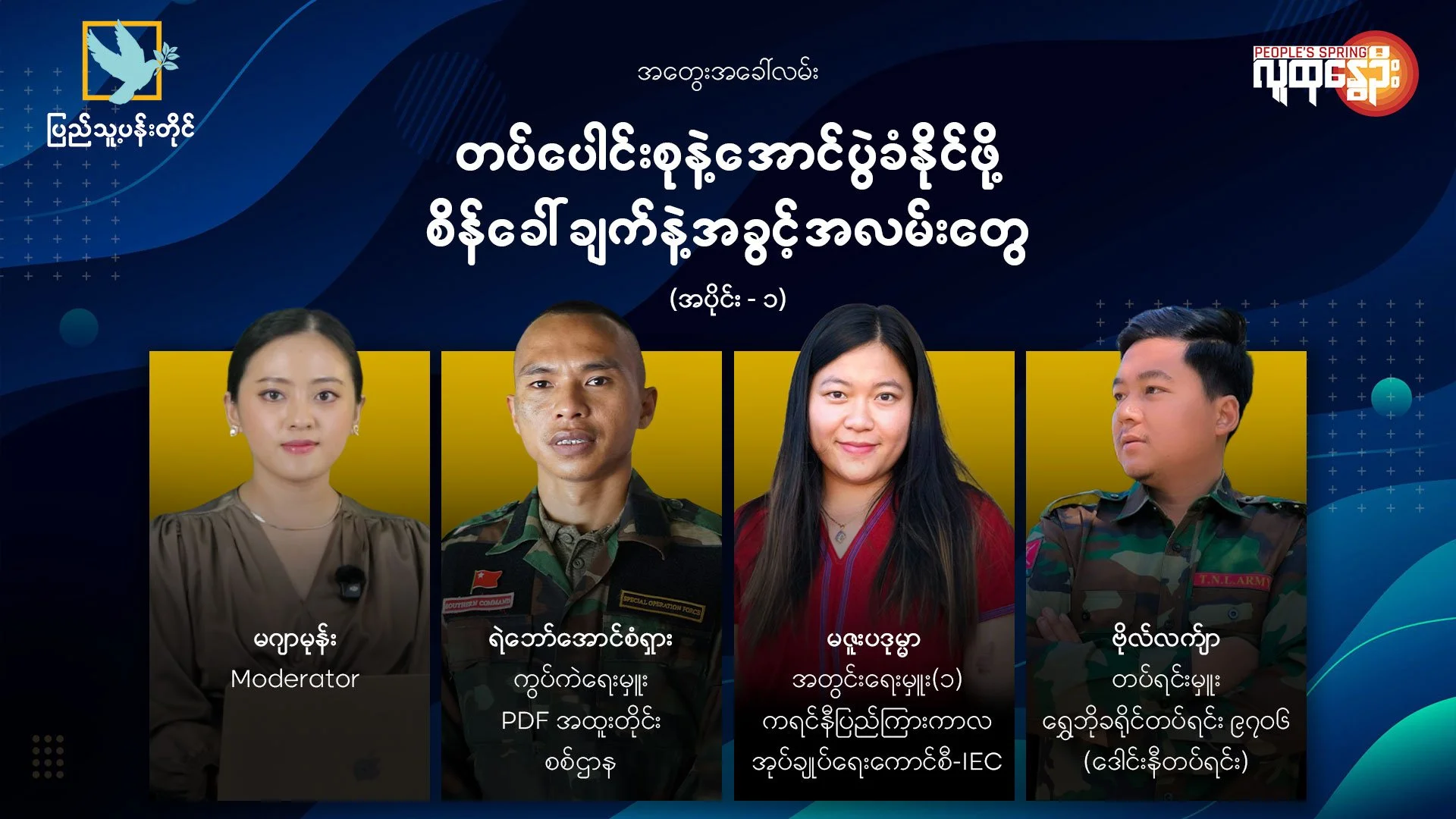
This talk show, jointly hosted by People’s Goal and People’s Spring under the Thought Process Program, brought together key voices from the ground to confront one urgent question: can the Spring Revolution achieve victory through an all-inclusive united front?
The discussion opened with a major development. On December 15, nineteen revolutionary groups, including the Karenni Nationalities Defense Force, announced the formation of the Spring Revolutionary Alliance (SRA). For many people, this signaled a long-awaited step toward unity after years of fragmentation.
Unity as a Strategic Turning Point
Ma Zu Padonmar, Secretary of the Karenni Interim Executive Council (IEC), welcomed the SRA as a practical response to long-standing public criticism. Since 2021, revolutionary forces have fought bravely but often without a single chain of command. The SRA, she explained, is not a symbolic gesture but a partial answer to that problem, especially at a time when the junta is again pushing sham elections and tactical peace offers to divide resistance forces.
Her message was clear: unity is not optional anymore. It is a condition for survival and progress.
Beyond Rivalry: Coordination, Not Competition
From the military perspective, Ko Aung San Shar emphasized that fears of rivalry between the SRA and the National Unity Government (NUG) are misplaced. Forces within the SRA recognize the NUG as the interim government and have already fought alongside NUG-affiliated PDFs and Ethnic Revolutionary Organizations (EROs) on the ground.
The real challenge, he argued, is not political legitimacy but overcoming personal authority, unit pride, and fragmented command structures. Whether under the NUG MOD, the SRA, or ERO command, what matters is decisive cooperation. Unity without ego is the revolution’s hardest but most necessary task.
Lessons from Karenni: Building Systems, Not Just Armies
One of the most concrete examples came from Karenni State. Ma Zu Padonmar described how the IEC built three pillars of governance: interim administration, legislature, and judiciary. On the military side, the Joint Chiefs of Staff (JCS) was created to coordinate operations among multiple armed groups.
This did not instantly create a single army, but it laid the foundation for trust, coordination, and long-term vision, including the future goal of a United Karenni State Army. The lesson for the wider revolution is powerful: effective resistance requires institutions, not only weapons.
Trust Forged in Battle
Bo Let Yar reflected on cooperation between central Myanmar (Anya) PDFs and northern EROs during Operation 1027. Even when territories were later relinquished due to international pressure, especially from China, he stressed that trust built through shared sacrifice does not disappear. Temporary ceasefires do not erase common goals.
Across the discussion, speakers returned to one shared understanding: those who have fought together can reunite again. Trust earned on the battlefield is the strongest glue for a future united front.
From Fragmentation to a Nationwide Strategy
As the conversation deepened, a strategic consensus emerged. Controlling rural areas alone is not enough. To dismantle the junta, revolutionary forces must coordinate attacks on key military, economic, and administrative pillars in places like Yangon, Nay Pyi Taw, and Mandalay. This requires shared resources, unified planning, and a willingness to prioritize national strategy over local control.
The SRA, NUG MOD, and EROs were repeatedly described as three necessary pillars. None can succeed alone.
A Holistic Revolution
In her closing reflections, Ma Zu Padonmar reframed the revolution itself. This is not only a military struggle. It is a systemic transformation that must dismantle militarism, patriarchy, and centralized domination. Women, ethnic minorities, displaced communities, and civilians across all regions are equally targeted by the junta and equally responsible for shaping a federal democratic future.
Unity, she reminded listeners, does not mean sameness. Like a family, it means negotiation, compromise, and collective responsibility.
Why the SRA Matters Now
After nearly five years of resistance, the speakers agreed on one thing: the revolutionary forces already possess greater manpower and experience than the junta. What remains is consolidation. The emergence of the SRA is not the end point, but it is a necessary and timely step toward a nationwide united front.
If revolutionary forces can set aside self-interest, share resources, and act with political will, unity is no longer an idealistic dream. It is a reachable strategy, and perhaps the decisive turning point of the Spring Revolution.