"How should we deal with the pressures for dialogue and negotiation?"
As everyone knows, due to the internal instability following the military coup in Myanmar, some foreign and neighboring countries have been pushing for a political solution through meetings and negotiations.
If such dialogues actually take place, when negotiating and reaching agreements, it is crucial to determine what the revolutionary forces' "absolute non-negotiable Red Lines" should be, and how firmly those points should be maintained.
These positions should not rely solely on the agreement of the leadership. It is also necessary to consider how to prepare in order to achieve a common stance that incorporates the desires of the public and all revolutionary forces on the ground.
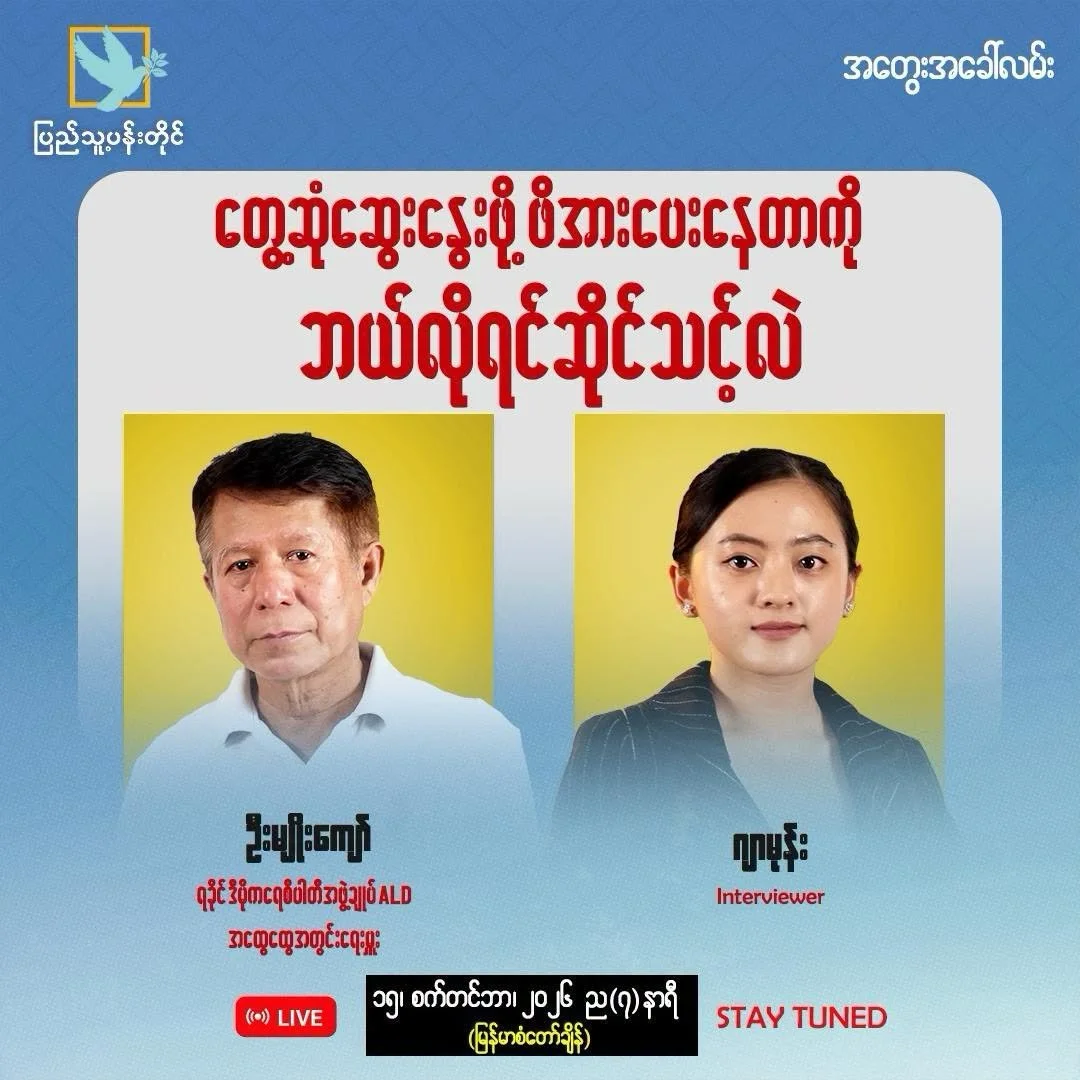
To analyze and discuss these topics, U Myo Kyaw, General Secretary of the Arakan League for Democracy (ALD) party, has been invited to the "Ideological Path" program of People's Goal, presented by interviewer Ma Jamone.
Read the full interview below:
Interviewer: As revolutionary forces, what should be the uncompromising standards that must be upheld?
Interviewee: From my perspective, and let me just state that this is my personal view, the revolution that emerged following the 2021 Spring Revolution military coup has cost the country dearly. The sacrifices of the youth, including their lives, blood, and sweat, are immense. It is not just the youth, because civil servants and CDM staff have also made tremendous sacrifices with their lives. Up to this point, over a period of more than five years, the innocent people of our country have had to give up their lives.
Because of all this, those on the revolutionary front chant the slogan that there is nothing to negotiate when it comes to blood debts. However, since we come from a political platform, negotiation is something we inevitably have to do. But under what circumstances should we negotiate? We need to look into the faces of the youth and civil servants who sacrificed their lives and futures, and we need to acknowledge their souls.
Furthermore, in the Spring of 2021, our primary political demand was the establishment of a Federal Democratic Union, which is a goal recognized by both the revolutionary and political spheres. That is our core objective. Only by establishing and implementing this federal democracy can the country achieve peace and ensure a better future for our nation. Regarding the establishment of this federal democracy, our demand is that it must be a Union comprised of states based on the electoral mandate of the people, ensuring the right of ethnic people to self-determination and the right to shape their own destiny.
In other words, the Union must be an amalgamation of states structured upon the inherent rights of state residents and ethnic nationalities. We have consistently advocated for this principle all along. That is what I am emphasizing. We stated this at Panglong to gain our independence in 1947, and the 1960 separate principle proposal from Shan State was also exactly this. Throughout history, starting from the 1988 uprising and the subsequent establishment of political parties, our discussions have been based on the premise of forming this Union centered around the eight major ethnic nationalities. Therefore, from my perspective, the formation of an egalitarian Federal Union is what I believe to be our most fundamental foundation.
Interviewer: In order to build a common stance, what kind of efforts should be made among yourselves first?
Interviewee: Regarding the establishment of a Federal Democratic Union, whether it is the revolutionary front, the political front, or other active movements today, everyone accepts this terminology. However, when it comes to the question of what kind of federalism, that is where the divergence begins. We have continuously stated our position that our country is primarily composed of eight major ethnic nationalities. Therefore, we have consistently argued that this Federal Union must be formed with states based on these ethnic nationalities.
What happens when we say this is that the Bamar or Myanmar people, who are among the ethnic people in our country, do not have a designated state. If they were to be recognized as one ethnic nationality and form one state, it would make it much easier to integrate and form a Union of states. When we articulate this concept, that is exactly where the divisions start.
Another point is that in today's revolution, over the past five years since the coup, people have come to realize that they too are subjected to the oppression of the military dictatorship. The existence of our country, the instability, and the ongoing internal revolution are struggles that have been continuing since independence. People are revolting because they were denied their fundamental ethnic rights, equality, self-determination, and the right to shape their own destiny. In the past, people were somewhat detached and felt as though these issues did not concern them. But now that they are directly affected, they feel the pain. Once they feel the pain, the common destination we all want to reach becomes the same, but the problem lies in how we unite and organize ourselves.
For instance, currently, our ethnic states have not yet become true federal states. Yet, on the other side in the regions, federal units are suddenly abundant. These issues are creating significant hurdles for our unity. Furthermore, regarding the National Unity Government mentioned in your previous question, are they truly representing the Union, or are they representing the Bamar? The positioning and stances of their leaders are quite questionable. Saying this might stir up some controversy, but this is the reality.
I might drag on a bit here. Since the 2021 coup, back when the National Unity Consultative Council had not yet been formed, I spoke with figures who were deeply involved in political leadership just days after the coup. I suggested to them that a Federal Army must be established. I suggested this because ethnic nationalities in Myanmar have their respective revolutionary armies, but the Bamar did not. So I advised them to establish one as well, suggesting that if they did so and we all unified, the revolution would progress much faster. However, it did not materialize.
Therefore, coming back to your question, in order to achieve unity among ourselves, we will need to have extensive discussions. In certain areas, if things are simply not working out, we must be willing to remove or sideline them. The youth of this era, or rather the emerging leaders since we are getting older, need to be given their turn. We need to allow them to build the kind of Union they envision based on their own ideas and concepts. Our country is currently missing true leadership. National unity is something people frequently talk about, but in reality, it is a very difficult task to achieve, so I would advise that we need to be more flexible to make it happen.
Interviewer: In order to build a common stance that everyone agrees on, and to ensure that the voice of the Rakhine ethnic group is not lost in future dialogues, what kinds of policies and mechanisms need to be in place?
Interviewee: As for our party, ever since its establishment, our stance has been that this Union must be a genuine Union. You have to remember that the party was founded in 1988, and back then, it was not that the term federal did not exist in our country, but that we were not allowed to use it because using it would cause trouble. Therefore, the principle of a genuine Union, which means a Union comprised of fully empowered states based on equality and self-determination, is something we have held from the very beginning.
That is precisely why we formed a political party alliance back then called the United Nationalities League for Democracy, which encompassed diverse ethnic groups. Even up to winning the 1990 elections, the party, along with the National League for Democracy and our ethnic alliance, issued a joint declaration based on the genuine Union principle. We have been advocating for these concepts all along.
However, in the current era, the nature of the revolution has shifted somewhat. Instead of prioritizing the Union, various factions have started looking out for their own specific interests, and the state of the country has become like that.
The education system imposed upon us and the systems designed to train civil servants have gradually driven us further apart. Unity becomes unattainable, and it became a culture of pleasing superiors, oppressing subordinates, nepotism, and favoring one's own circle. Operating under such systems, everything was ruined.
Even the previous governments after 2010 convened peace dialogues, but we talked endlessly about peace while the revolutionary forces that were once united internally ended up fracturing. This is not the correct path, and it yields no benefit for the country while bringing suffering to ethnic populations.
Therefore, we need to start correcting these habits starting today. Even in today's revolution, there are many toxic organizations and individuals that simply need to be removed, and I am sure media professionals notice this as well.
Because of all this, the Rakhine stance today is exceptionally strong and clear. Within the Union, the actions of the Rakhine today are something to be admired and proud of. Speaking as a Rakhine myself, I am proud of and admire the current state of Rakhine State and the Rakhine revolutionary forces today, which is truly something to emulate.
Another message I want to convey is that the Rakhine people are not just fighting the revolution solely within Rakhine State, but are actively participating in the revolution all across Myanmar. The same applies in the political arena. Take our party for instance, because since 1988, we have been fighting for Union affairs and making political demands for the Union up to this very day.
Similarly, the revolutionary groups fighting on the other side are not confining their revolution to Rakhine State alone, as their roots stretch across Myanmar in Kachin, Karen, and Shan states. Therefore, we need to link hands as much as possible with the revolutionary forces present in those areas and ensure our voices are heard together.
One final point I want to make is that it has only been a decade since the western military front was opened in Myanmar, yet it has been the most successful to the point where it is now threatening Naypyidaw itself. Therefore, that front needs to become even stronger, and I believe that only then will we be able to completely uproot the military dictatorship system.