What Does Peace Mean? — The Path Toward Justice, Accountability, and Transition
“What does peace really mean?”
In Myanmar’s current political context, peace is something that many different actors speak about and claim to pursue — from the public and revolutionary forces to the military that seized power, as well as the international community.
But an important question remains: When these different actors speak of “peace,” what do they actually mean? What does their definition of peace include, and what are they ultimately seeking to achieve?
In this interview, we explore the meaning of peace within Myanmar’s current political landscape and examine the key conditions needed to achieve sustainable and lasting peace. The discussion also considers the roles of justice, accountability, and political transition in shaping a pathway toward peace.
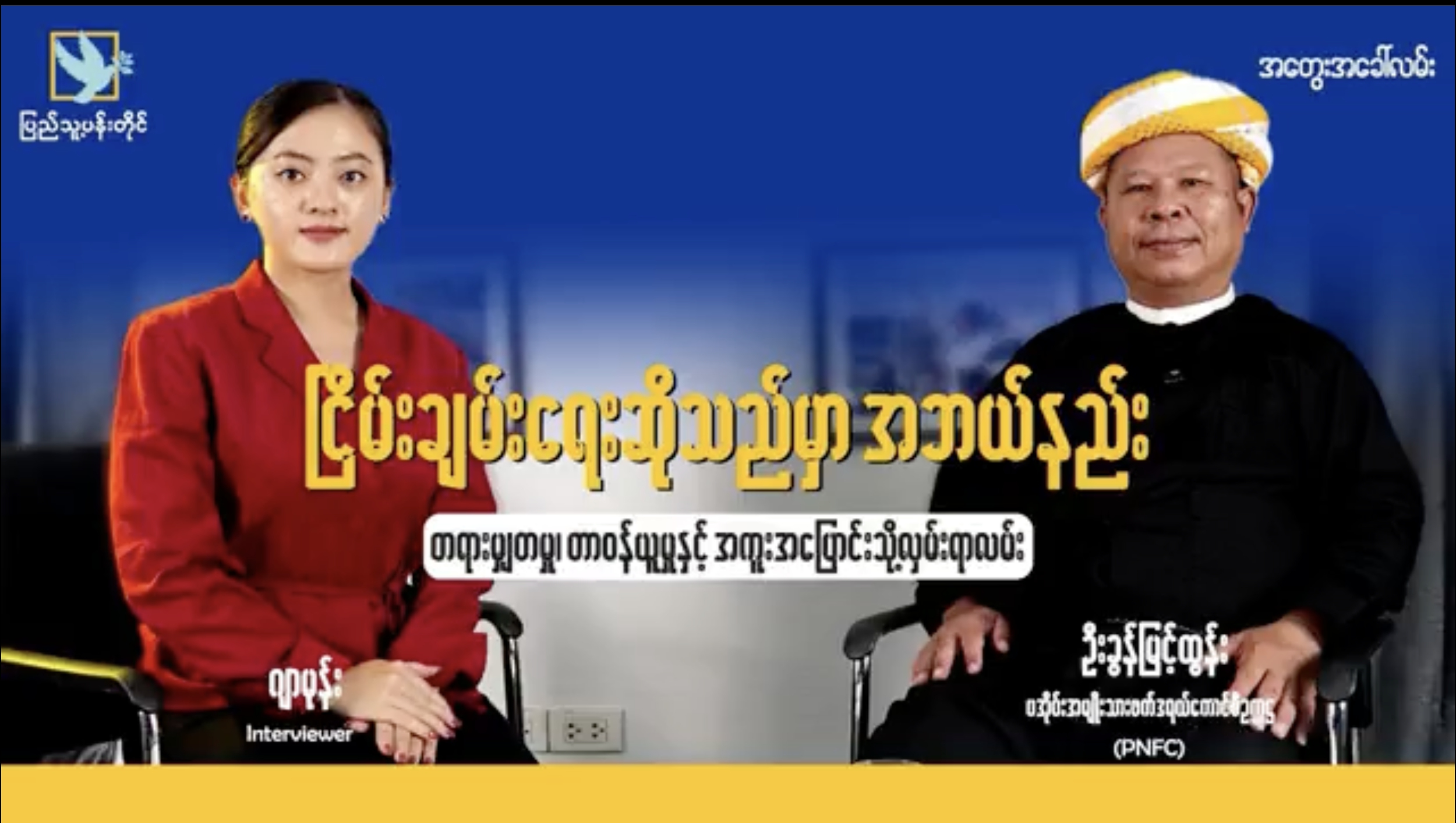
For this conversation, People’s Goal welcomes U Khun Myint Tun, Chairperson of the Pa-O National Federal Council (PNFC), to its “Path of Thought” program, with Ma Jamone as the interviewer.
Read the full interview below:
Interviewer: Today, we can see that various stakeholders have increasingly differing demands regarding the definition of peace. Given the current situation in Myanmar, how would you personally define peace?
Interviewee: In our country, the term peace is used under various pretexts, where people use it interchangeably and discuss it under different headings. Specifically, for the diverse people of our country, whether at the individual level, the ethnic or national level, or the level of the entire Union, true peace can only be achieved when the interests of all these entities are harmonized.
To elaborate, after World War II, the United Nations was formed. The primary mandate of the UN is to maintain peace and security. Peace and security are coupled together as the UN core responsibility. Therefore, when we talk about peace, it is deeply connected to stability and security. For all our citizens and diverse ethnic nationalities, whether individually, as an ethnic group, or as the entire Union, security is a fundamental necessity.
There have been times when people claimed peace was achieved. For instance, looking at recent events along the Chinese border, ceasefires were established. China policy emphasizes peace and stability. But what does stability actually mean in this context? Armed groups might agree to a ceasefire, and the gunfire might stop. However, do the local people truly feel peaceful in their hearts? Living and surviving under armed dictatorships and under the control of those holding weapons, the public is subjected to the Three Khas, which means “come when called, do as told, and do not talk back”. They are also subjected to the Three Was, which means “eat your fill, stay far away, and do not interfere”. If the public is forced to live under such constraints, you might call the situation stable.
However, if we have no voice, that cannot be genuine peace. The interests of the public are absent. The interests of specific nationalities and ethnic groups are absent. The interests of the Union are absent, and there is no harmony. If this is the situation for a specific group or region, we cannot call it peace.
Therefore, our definition of peace means that for all diverse ethnic nationalities and the general public, whether individually, as an ethnic group, or as the entire Union, our interests must be in harmony. Furthermore, there must be security, as only then can we truly build peace.
Interviewer: To what extent has the current process of building unity and integration among the revolutionary forces progressed?
Interviewee: For all of us in this revolution, unity is an absolute must. We have all already accepted that we must be united to succeed, which is the main point.
Organizations like SCEF are striving for representation. Among the revolutionary forces, we already share the foundational understanding that unity is essential. On this basic premise, our stances align. Furthermore, among the revolutionary and political forces, there are roughly four different political stances.
First, the eradication of the military dictatorship and the establishment of a federal union. This is the mainstream political current today. This is where SCEF stands, and this is where we stand as well.
Second, some are actively working to eradicate the military dictatorship, but they are not very vocal or explicit about building a federal union. That is one stance.
Third, some advocate for building a federal union, but they do not talk about eradicating the military dictatorship.
Fourth, there are those who follow China policy of Peace and Stability. They speak neither of building a federal union nor of eradicating the military dictatorship.
Mainly, among those who share the political ideology that a federal union can only be built after eradicating the military dictatorship, we must first unite. Both SCEF and we stand on this foundational principle. Because we share this mainstream political current and the fundamental belief that unity is a must, I believe we can definitely build unity among ourselves.
For example, in the past, we held the Laiza Conference. At that time, we had the UNFC, which is the United Nationalities Federal Council, an ethnic alliance. When we convened the ethnic conference in Laiza, both UNFC member organizations and non members attended. We gathered, discussed, and made collective decisions. We successfully established the Laiza Agreement.
Therefore, under the current circumstances, I believe that achieving unity among those standing together in the mainstream political current is not a difficult task.
Interviewer: Since the emergence of a federal democratic union requires the total uprooting of the military dictatorship, given this stance, is it even possible to hold talks with the military that has seized power? Is the dialogue that the international community is urging even feasible?
Interviewee: First of all, nowadays, when people hear the word dialogue, they assume it means going to Naypyidaw. We want to reiterate time and again that dialogue does not mean going to Naypyidaw. Why do we want dialogue? We want to eradicate the military dictatorship in our country, build a federal union, and achieve peace. That is our goal. If going to Naypyidaw to negotiate with the military results in the survival of the military dictatorship, the failure to build a federal union, and no real peace, then what is the point? Do we need to go? That is one thing.
So, if the military wants to engage in dialogue with us today, the very first prerequisite is that the military itself must accept the eradication of the military dictatorship. The military accepting the end of the dictatorship was actually the original founding principle of the Burma Army (Tatmadaw).
During my time serving in the National League for Democracy, I had the privilege of working alongside figures like former NLD Chairman former General U Aung Shwe, Colonel Lun Tin, and Colonel Lwin, who were the great figures that founded the Tatmadaw alongside General Aung San. Furthermore, NLD Patron former General Tin Oo and others stated that when the Burma Army (Tatmadaw) was founded, its core principle was that the people are the mother and father figures.
They were deeply embittered that, after independence, this was twisted into the Tatmadaw is the mother and father figures. I have the evidence of what Colonel Lun Tin said to the media. As we always say, they voiced this publicly. Colonel Lun Tin said that they were good commanders and good soldiers, but because they were dragged into politics, they suffered, the military suffered, and the country was ruined. That is what they said.