

Same Tactics, New Era: Ma Khin Lay on Propaganda, Boycotts, and the Power of the People
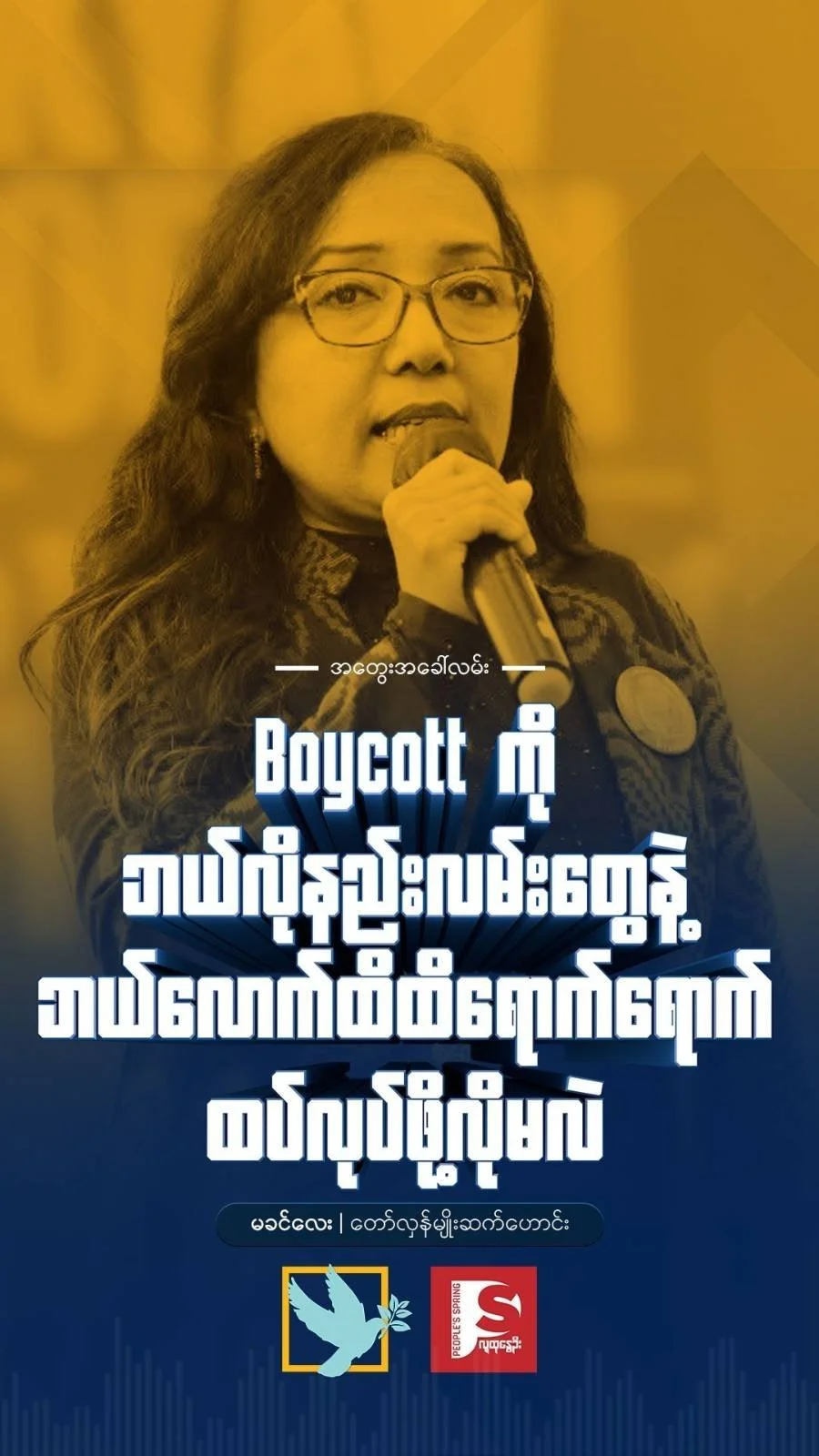
This blog is adapted from an interview segment featuring veteran revolutionary Ma Khin Lay, extracted from a talk show jointly organized by People’s Goal and People’s Spring under the Thought Process Program. While the full session included multiple panelists, this piece focuses exclusively on Ma Khin Lay’s analysis and reflections from the wider dialogue.
“Times have changed, but the current military junta’s tactics remain the same.”
Old Habits That Never Died
Ma Khin Lay begins with a blunt observation. Despite decades passing and slogans urging change, the military has never truly updated its methods. Lies, smears, defamation, and manufactured narratives remain their core tools.
She explains that junta propaganda usually operates on two tracks. The first is character assassination. Opposition leaders are attacked through personal slander, false rumors, and humiliation designed to erode public trust. She recalls how Aung San Suu Kyi was repeatedly targeted, from attacks on her family life to public mockery using caricatures and staged performances.
The second track is self glorification. The military portrays itself as a tireless benefactor of the people. In the post 1988 era, infrastructure projects like dams, bridges, and roads were turned into propaganda stages, with celebrities dancing in front of construction sites in exchange for privileges such as car import permits or land. According to Ma Khin Lay, these were not acts of ignorance, but of self interest.
The People Were Never Foolish
Even in earlier decades, she stresses, people were not blind. They may not have used terms like boycott or social punishment, and technology was limited, but resistance existed in quieter forms. Communities found ways to withdraw respect and support.
What has changed today is not awareness, but courage. Ma Khin Lay reflects on how, after 1988, even family members would cut ties with those involved in political movements out of fear. Social punishment was imposed on activists by society itself.
Now, the situation is far harsher. People face arrest, torture, and even death for symbolic acts like wearing flowers or changing profile pictures. Yet, they still participate in silent strikes and other forms of resistance. For her, this proves that political awareness was never low and is now stronger than ever, even under extreme fear.
Propaganda for Whom?
Ma Khin Lay questions whether the junta’s propaganda is even meant for the general public anymore. She believes it is primarily aimed at maintaining loyalty within military circles and among blind supporters. The repetition of outdated formulas suggests that the junta itself may be trapped in a cycle of its own making.
She also points out how propaganda has diversified. Beyond films and media, the military exploits religious figures, power hungry politicians, and wealthy seeking artists to normalize the current situation and present repression as everyday life. But no matter how hard they try, she argues, society has already moved into a new political and technological era that the junta cannot catch up with.
Making Boycotts Work
On social punishment and boycotts, Ma Khin Lay is clear. They only work if they are consistent.
She warns against emotional cycles, moments of outrage followed by indifference. Instead, she proposes a more strategic approach. Those who have supported authoritarianism across generations and openly return to it when convenient should face permanent and uncompromising boycotts. Collaborators in propaganda campaigns should be clearly identified and treated as such.
At the same time, she shows nuance. Not all artists are the same. Some remain inside the country, silent or cautious, avoiding open collaboration even under pressure. The challenge, she says, is how to prevent them from becoming active supporters of the junta and how to keep pathways open for them to return to the people’s side. Persistent, sustained boycotts combined with continuous public reminders from influential voices are key.
What the Revolution Must Prepare For
Ma Khin Lay acknowledges a difficult truth. Fatigue has set in, even among those committed to the revolution. Economic hardship and prolonged struggle have introduced doubt. People worry not because they believe the junta, but because they fear international recognition of sham elections and imposed authorities.
Her message to revolutionary forces, including the NUG, is direct. Information dissemination and public relations must be handled with greater consistency, clarity, and professionalism. Disinformation should not always be ignored. At times, timely clarification is essential to prevent demoralization.
She warns that while past smear campaigns focused on single figures, future tactics may aim to divide the people from revolutionary leaders or sow distrust within the movement. Preventing these fractures, she argues, is a shared responsibility.
The Power That Still Holds
Ma Khin Lay closes by returning to a familiar idea, the power of the powerless. In Myanmar, she says, that power has always belonged to the people. Revolutionary forces continue only because of public support. As long as that support remains, the junta cannot win.
The central task, then, is not to underestimate the people, but to protect trust, maintain connection, and communicate honestly. Without the people, no revolution survives. Without the people, no dictatorship endures either.