
Silence as Power: Nyi Thuta on Ideology, Fear, and the Intellectual Revolution
This blog is adapted from an interview segment featuring Nyi Thuta, extracted from a talk show jointly organized by People’s Goal and People’s Spring under the Thought Process Program. While the full session included three panelists, this piece focuses solely on Nyi Thuta’s insights from the wider discussion.
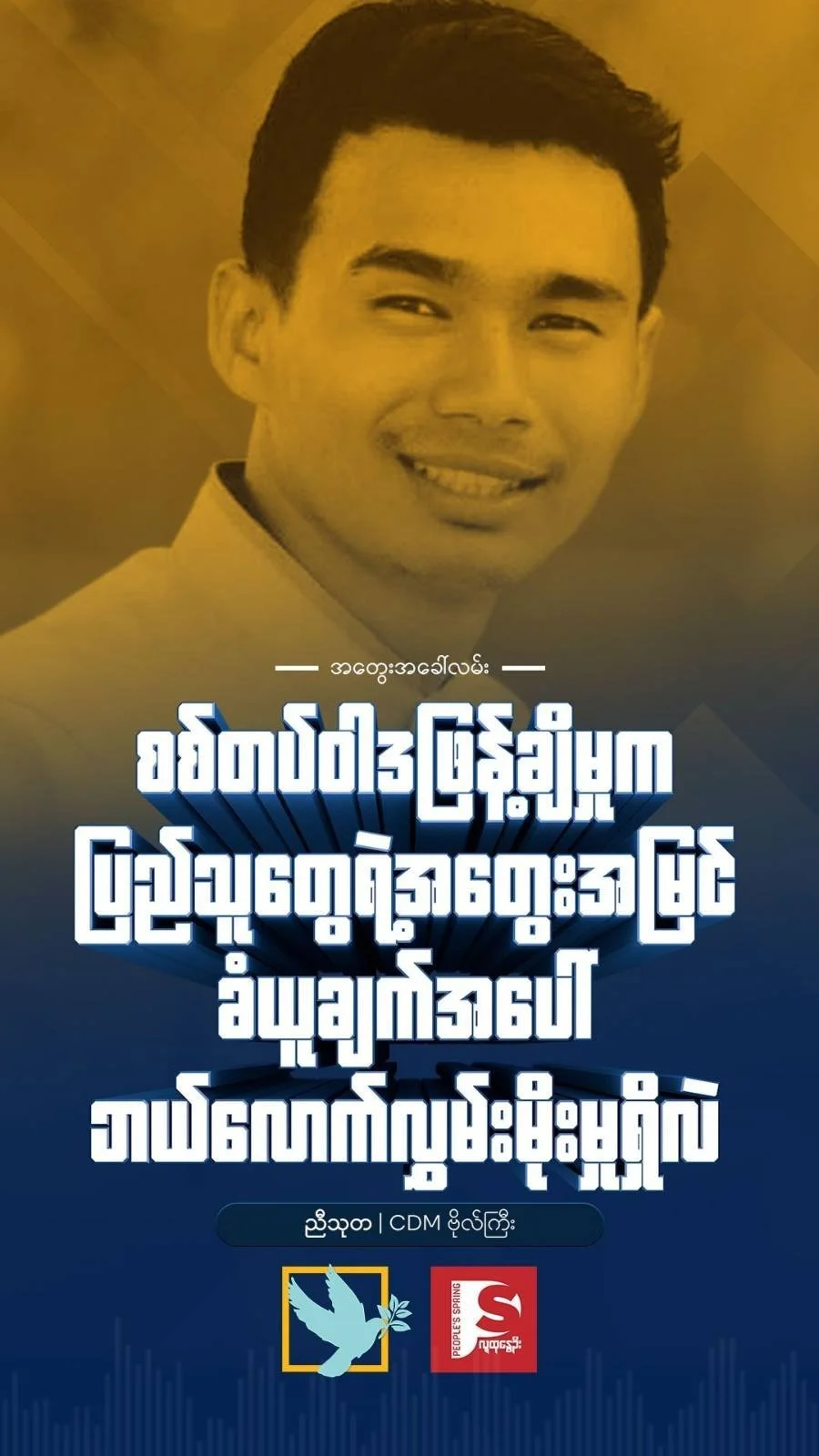
Nyi Thuta
“They have a mentality that demands total support from all citizens.”
Not Just Psychological Warfare, but Ideological Control
Nyi Thuta begins by reframing the conversation. Rather than seeing the military’s actions purely as psychological warfare, he describes them as a long running attempt to reshape public ideology. For decades, the military has tried to mold how people think, what they believe, and whom they obey.
Yet, he argues, these efforts have largely failed. Whenever people were given a genuine chance to choose, such as during periods of civilian governance, they demonstrated clear judgment about national goals, policies, and leadership. This shows that the problem is not public ignorance, but the military’s refusal to accept the people’s interests and choices.
Exploiting Self Interest, Not Strength
According to Nyi Thuta, the military’s influence does not come from competence or moral authority. It comes from exploiting individuals driven by self interest, fear, or the desire for status.
He points to religious figures as an example. When monks fear losing social standing or influence, some choose to cooperate with the military. Through them, the military gains indirect access to followers and legitimacy. Over time, these individuals become tools of the regime, often without fully realizing how deeply they are being used.
In reality, Nyi Thuta says, there are only two sides. The military and the resistance. Both are fighting not only on the battlefield and in politics, but also over the ideology of the people.
Soldiers Without Uniforms
One of Nyi Thuta’s most striking observations is that citizens living under military rule are often forced into becoming “soldiers without uniforms.” Through pressure, coercion, and manipulation, the regime pushes people to act in its interest, even without formal enlistment.
Military leaders want power and legitimacy. To achieve this, they demand public obedience and visible support. This explains why propaganda is relentless and why neutrality is never acceptable to them.
Who Is Most at Risk of Propaganda?
Nyi Thuta draws a clear distinction between adults and children. Adults, he believes, are difficult to sway. They already understand right and wrong and have lived long enough to recognize injustice. This was evident during the 2021 coup, when people across generations stood together in resistance.
Children, however, are far more vulnerable. Ideas absorbed in early childhood can shape beliefs for life. He warns against the normalization of soldiers entering classrooms, building familiarity with children, and embedding ideology at a young age. These actions, he stresses, should never be underestimated.
What the Military Truly Fears
Despite its displays of power, Nyi Thuta describes the military as deeply insecure. Having never lived as free individuals, its leaders do not understand the value of freedom, knowledge, or love. In their worldview, compassion is weakness and obedience is virtue.
This is why silence frightens them.
Silence, or deliberate indifference, is a form of power. When people ignore the regime, refuse to engage emotionally, and deny it recognition, the illusion of legitimacy collapses. For those living inside the country, where open resistance may be impossible, ignoring the regime becomes a powerful and accessible weapon.
Advice to the Revolutionary Side
Nyi Thuta believes that those who join the revolution share core values. A belief in freedom, compassion, knowledge, and a refusal to harm others. At the heart of these values lies intellectual freedom.
Demonstrating the worth of these values, he says, is itself a form of mobilization. Building communities rooted in care rather than fear is part of the struggle. The revolution is not only about overthrowing a regime, but about shaping a society where younger generations can live without terror.
He urges people to reflect deeply. If we are human, why should we accept lives ruled by fear? Why should we trade intellectual freedom for money, status, or comfort? Once the value of freedom is truly understood, everything else becomes secondary.
An Intellectual Revolution
Nyi Thuta concludes by calling the struggle what it truly is. An intellectual revolution.
Because this revolution is rooted in ideas, values, and awareness, those on the revolutionary side have a responsibility to keep sharing knowledge that helps people live fuller, freer lives. This ongoing exchange of understanding is not separate from resistance. It is its foundation.